in praise of 'ignorance'
I discussed this short article - ‘In Praise of Ignorance’ in a book club yesterday and wanted to think through some topics.
The shape of perception
Deutsch argues that ’not knowing’ can itself be a form of knowledge, and that it is valuable. An example he gives is : Take the word : ‘COOL’. If I ask you to describe the ‘word’ without reading it, you might struggle - it’s a curved line, convex to the left, with two circles next to it and then two perpendicular lines. But in seeing that word - you thought ‘cool’. - you couldn’t help it.
However for someone who doesn’t speak English that exercise would be much easier, and they would not ‘think cool’.

I’m only a beginner in learning Japanese- but I actually struggled to read the English…
The point is : knowledge shapes your perception. All observation is theory-laden. And importantly once you know something, you are altered - your perception and world view, and how you process subsequent bits of knowledge.
Deutsch argues for ‘wilful ignorance’. The deliberate choice to remain innocent of certain knowledge - and that this is actually valuable.
Deutsch gives the example of Faraday and Maxwell - who together discovered a complete classical theory of electromagnetism. Faraday provided the explanatory hypothesis; Maxwell, the equations.
Importantly Faraday is said to have been ‘incapable’ of learning mathematics. Deutsch argues that him not knowing mathematics, likely contributed to how he perceived and interpreted the information. If he knew mathematics, he might not have had the same insights/approach/conjectures that led to his theories.
Essentially by learning something, you shape your perception and you might be shutting off other avenues of thinking about a problem. Like in the example of cool- you’ve lost your innocence in some way.
This goes to the way knowledge is acquired. It is not simply information poured into the mind. It is not ‘downloaded’ like the Matrix. It’s actually your mind actively wrestling with the topic - putting forth conjectures(guesses), trying to refute them, come up with examples and see whether it fits into the other pieces you’ve thought through.
Of course we know this, when we read something, we don’t memorise it - we take away the broad concepts - we might even have entirely new unrelated ideas that spring from this internal monologue.
The cost of forced learning
Deutsch argues that acquiring unwanted information (coerced learning) is harmful for a few reasons
One is that you have wasted time that you could have used to acquire ideas you want to acquire. He talks about knowledge being ‘valuable’ - to whom - the person acquiring it, when - at the time of acquiring it.
Secondly, and more importantly, you’ve destroyed the innocence that comes from encountering an idea for the first time. When fuelled by genuine curiosity - you tend to go into it more deeply, more enthusiastically, you ask questions, conjecture and criticise it.
When you are forced (as you are with school), you don’t really actively wrestle with it, and thus you lose this first unclouded perspective of approaching an idea.
Like the word COOL, you’ve lost that first ‘innocent’ perception of it.
Innocence, properly conceived, is a positive attribute. It is the ignorance that comes from a voluntary decision not to engage (or not to engage yet) with a particular area of complex knowledge. Innocence in that sense is essential for all genuine learning. Compulsory teaching is the destruction of innocence, forcing the victims to waste the opportunity, which comes only once in each lifetime, to encounter that knowledge for the first time.
Trying to ‘pump knowledge’ into someone that doesn’t want it, can result in “permanent destruction of the recipient’s ability to engage with information of that type”. How many people have closed their eyes to the beauty of mathematics or physics, through ‘bad teaching’ and forced ‘education’? (I count myself in this category to some extent).
The curse of knowledge
There is this concept of the ‘curse of knowledge’. Once you know something, it is hard to remember what it was like to not know.
A metaphor I liked is that when you are learning, you are building up this scaffolding - explicit step based knowledge. Think about driving a car - you need to think where and what your feet are doing - its all conscious and thought through. But at some point, it becomes automatic, and what happens is that your mind just destroys that scaffolding. You literally forget how you got to that point- and often can’t teach it.
Someone in the group raised a point, that when he was learning martial arts, he would diligently keep journals about his learning process (all the way from beginner to master)- and in doing this he retained some measure of that beginners mind and was able to teach his students better.
It’s the classic ‘Beginners mind’ from Zen Buddhism. Seeing through fresh eyes unclouded by prior conceptions, wilfully choosing to work on a problem, and wilfully ignoring others- is how we truly learn.
Fun
The fun criterion is about choosing problems that you find meaningful and fun. i.e. following your genuine intellectual curiosity. This can be misconstrued as giving up when it becomes hard - or having to ‘force yourself’ through a problem to understand it.
This is a gross misconception. People run marathons - this is hard, and they do it willingly, and might I say sometimes, because it is fun and meaningful to them. This is the same with knowledge acquisition. People work on problems that they find valuable to work on.
Importantly, a big part of that is choosing to be ignorant about other problems that you don’t care about.
When a person is learning successfully, the trail of wilful ignorance, as it were, that they leave behind them—the sequence of rejected opportunities to acquire information—characterises their creative process just as faithfully as the sequence of problems that they faced and solved. Indeed, a well-adapted and sophisticated pattern of ignorance in a person’s mind, having evolved as the result of that person’s successive rational and creative choices, is itself a form of knowledge.
A good metric I find is that when I’m having fun, I lose all sense of time. I’m in a state of flow.
Becoming what you think
Every time you learn something, you become a different person. You become the kind of person who has those kinds of thoughts.
Every human is unique- in that they have this built up model of how stuff works that is entirely individual. You’re a combinatorial mosaic of all of your life experiences, mental models, people you’ve encountered- essentially every moment of your life up to now, has led to this ‘unique’ you.
Importantly you can further shape the kind of person you become. What I find valuable about writing - you are essentially putting forth an idea in your own words (i.e. thinking through it) and seeing whether it makes sense.
“Self-writing is this kind of self-cultivation thing. The project I’m doing is basically turning myself into a certain type of person who is able to have these thoughts. The essays are kind of just exhaust from the project.” (Henrik Karlsson)
Writing is about turning yourself into the kind of person who has certain thoughts. It’s about intentionally crafting the way you see the world. Similarly, with what you choose to learn, and what you choose to ignore - the stuff you choose not to learn is just as important as the stuff you choose to learn,
Conclusion
Humans need to be excited all the time. It doesn’t matter what the subject is
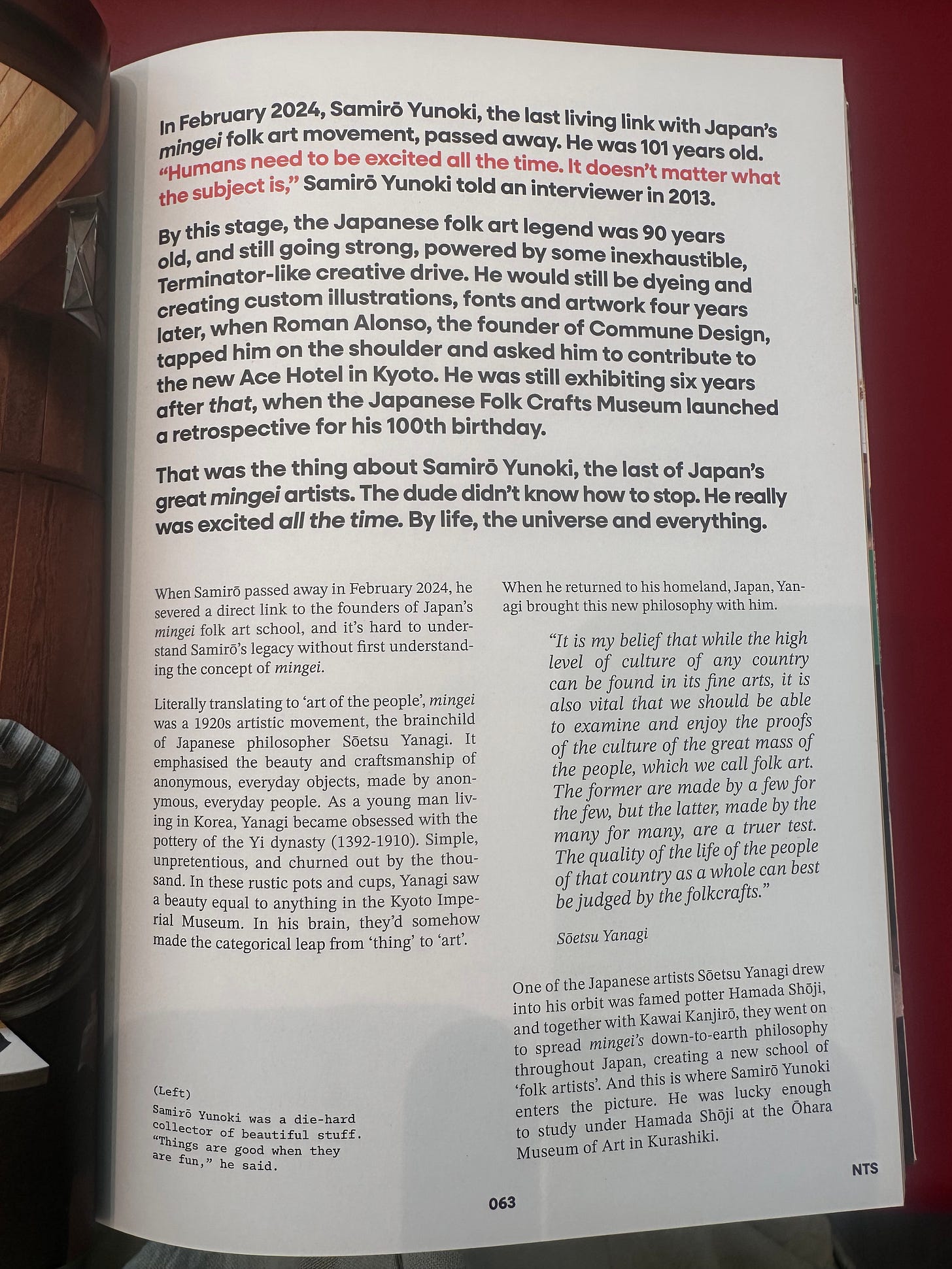
From the recent ‘Never Too Small’ magazine - focused on Japanese design
The world is full of problems. Humans are the universal explainers - the universal problem solvers who are able to dream of solutions and new ways of seeing.
Forcing someone to ‘think and care’ about a problem is destroying that innocent ability to approach it with your own volition and with fresh unclouded eyes.
Instead - follow your genuine intellectual curiosity. Work on problems that ignite your being - beautiful problems that you can devote your life to - and watch yourself transformed.
30
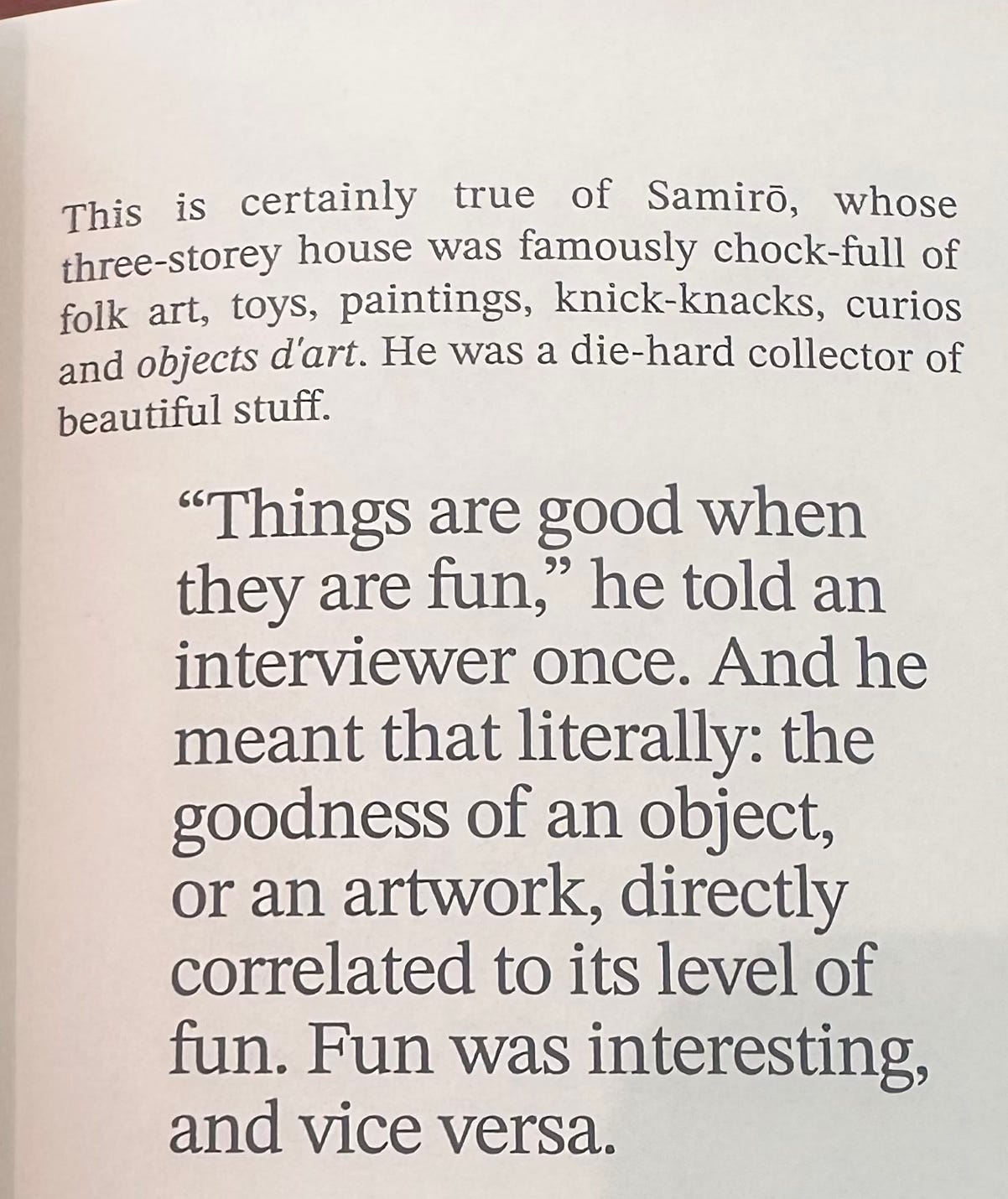
Last week, I walked the Camino de Santiago (last 115km of the French route) over 4-5 days to celebrate turning 30.
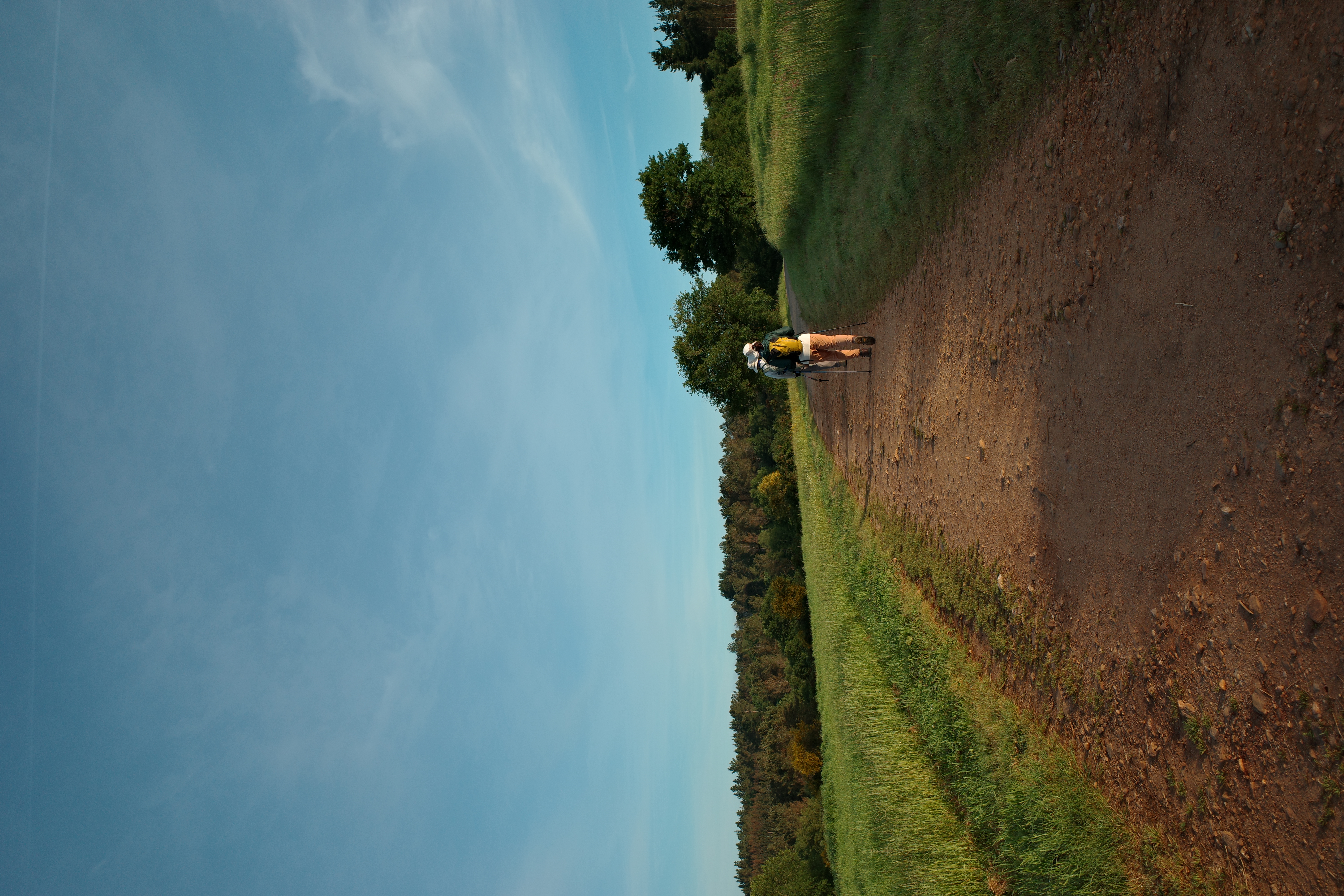
I came across a girl who was collecting bits of advice from people on the Camino in a small notebook. She asked me to write something, sign and date it.
I hesitated, having long seen the folly of giving advice (it’s too context dependent, too personal). But I paused for a moment, and wrote the first and only thing that came to my mind.
Live in a way that makes the younger version of you proud
I smiled and handed her the book and continued on my way.
-
I’ve had a mini tradition of writing a post about what I’ve learned at various ages (20, 25, 27) - but the older I get, the more the value of unlearning comes to mind.
My first point in my ‘20’ post was ‘You know nothing’ - and I don’t think truer words were ever spoken. Your younger self often holds wisdom that wouldn’t be accessible to you currently. Innocence is an un-jaded way of seeing, one that has not been hurt by the world, it’s the lens of a happy childhood (one that I will always be grateful for)
As we age, we inevitably accumulate more experiences, good, bad and all that comes in between. If we think of innocence on one end of the spectrum, then experience must be on the other - the process of ageing is crossing this.
But I want to challenge that view. I think growing older doesn’t mean the loss of innocence. One can choose to live in ways that reveal innocence once more - perhaps a richer, more mature form, one that only comes through the dance of loss and gain, pleasure and pain.
It’s as if the lens becomes blurry as we age, clouded by disappointments, social expectations, the weight of should-haves. If we don’t carefully take time to wipe off the grime and muck, we remain lost in a clouded view.
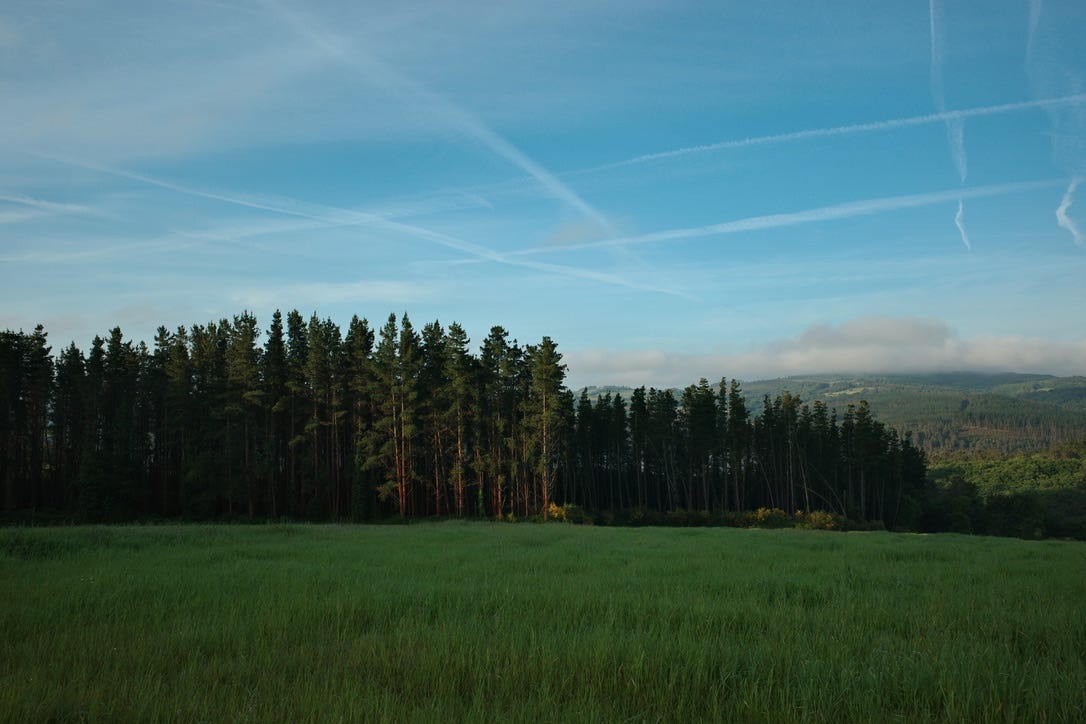
As I walk the Camino, in silence, 25-30-40km at a time, a certain heaviness drops. Perhaps the heaviness of expectation, or of tightly gripped futures or unchallenged desires.
It’s as if the lens, blurred by busyness and distraction, clears itself, revealing only the strips of golden light streaming through the trees, painting each step of the path ahead.
The silence clears. Because in the silence, you let the stories surface, and let them be fully felt.
An unlearning, as I said. It mirrors what I find in meditation retreats. A clarity beyond words.
I let myself be heartbroken. I let myself be joyous, ecstatic, lonely, sad, angry, forgiving, grateful. Whatever I feel converges onto that last emotion: gratitude.
Morbid as it sounds, I picture the end - and instantly become filled with the wonder of existence. The crunch of leaves under my feet, amidst the chirping birds and wind through the trees, create a grand orchestra playing the eternal tune - a sense of oneness perhaps. Ephemerality, really sat with, turns into awe, gratitude and ultimately peace.
I crack open, little by little, until the tiny rivulets coalesce into larger and larger shards allowing this ephemerality pierce into the centre. I think again of a line that I always revisit: “the cracks are how the light gets in.”
And so on the Camino, I unlearn. Perhaps that is what I can say about turning 30. A listicle of advice turned instead into an admonition: sit and listen to it all, and let yourself be swept away in reality. Feel it all and feel it deeply.
And of course, make your younger self proud.
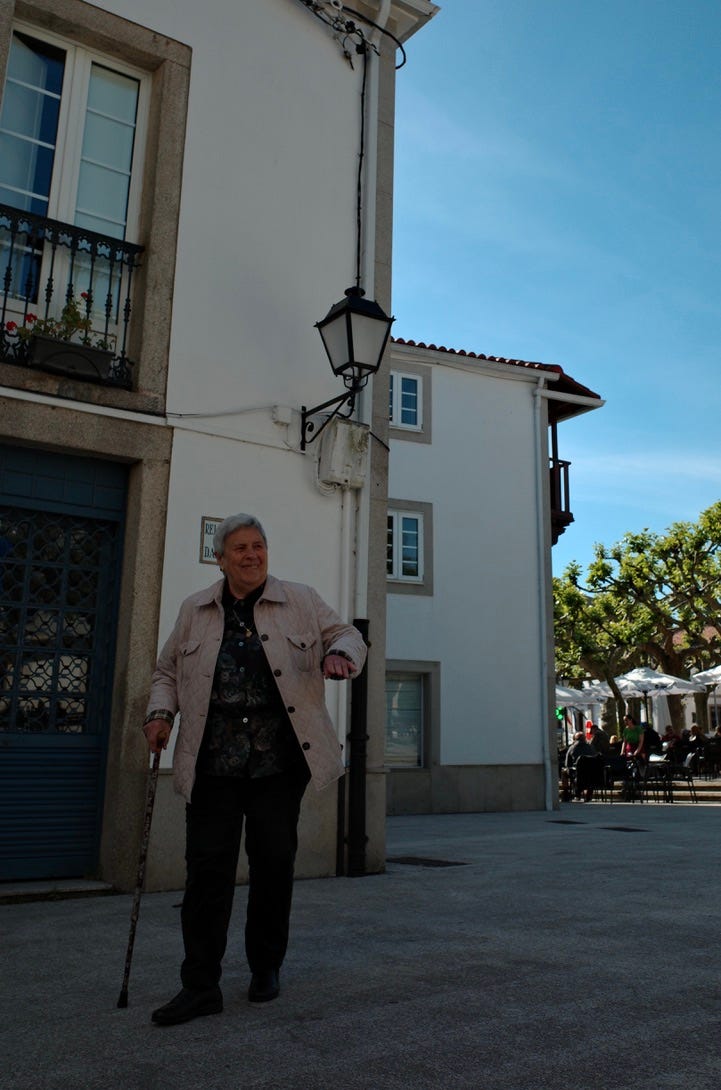


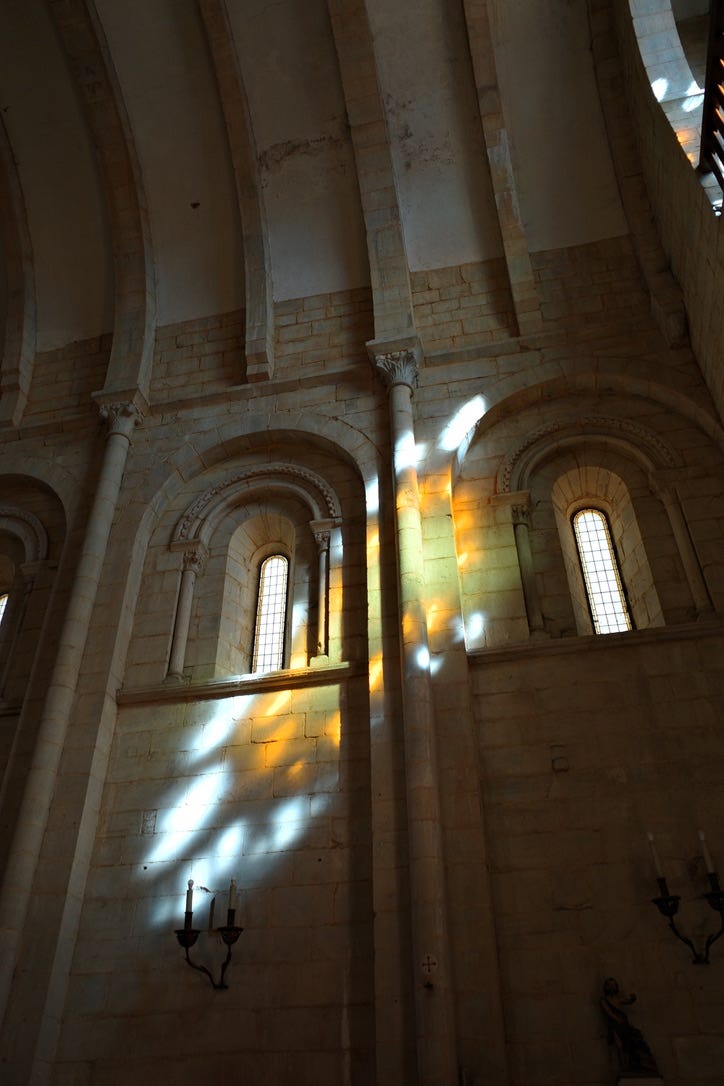
There Are Cathedrals Everywhere For Those With The Eyes To See
why beauty is objective
Trying to grapple with David Deutsch’s idea on why beauty is objective.
Beauty is not random or merely personal preference. When we look at a beautiful flower, a stunning piece of music, or an elegant mathematical proof, we’re not just having arbitrary reactions. There’s something about these objects themselves that creates the experience of beauty.
Beautiful things have “hard-to-vary” qualities Take a beautiful melody. Change one note randomly, and it usually becomes less beautiful. This suggests beauty depends on specific relationships between elements that can’t be arbitrarily changed without diminishing the beauty.
Artists go through conjecture criticism cycles When artists create, they don’t just make random choices. They recognise when something “doesn’t work” and make specific improvements. This process looks remarkably like problem-solving, suggesting they’re working toward objective standards.
We’ve made progress Our understanding of beauty has grown more sophisticated over time. We can appreciate more complex forms of beauty and explain why certain things are beautiful in increasingly precise terms The virtual worlds we create in video games, or the complex music we now create are much more deeper and more beautiful than the drawings on the wall of a cave
If we take the opposite view: beauty is in the eye of the beholder :
- All aesthetic judgments would be equally valid
- Artists wouldn’t need to refine their work
- We couldn’t make progress in aesthetic understanding
- Changing elements randomly wouldn’t typically reduce beauty
Since none of these consequences hold true, beauty must have an objective component that exists independent of our personal preferences. Beauty isn’t objective in the same way that weight or temperature are objective, but it’s also not merely subjective like a personal preference for chocolate over vanilla. Instead, beauty emerges from specific relationships and solutions to problems that can be recognised across different minds and cultures, even if our perception of it continues to evolve.