returning to blogging
I recently listened to an interview with Tyler Cowen and Rick Rubin, on the Tetragrammaton podcast. 1
He mentioned the difference between Substack and Blogging. Substack is better for long form essays of 1000-2000+ words that gets emailed out to people.
Blogging on the other hand, is much better for shorter posts.
Cowen mentions he treats his blog as a journal writing about everything and anything that he wants to explore further.
I see the value in this. Shorter form posts remove the barrier or anxiety of trying to write a coherent 2000 word piece. You’re free to think in public, play with half baked ideas and posit questions without answers. You can post links, threads, ideas much more frequently.
So this is what I’m going to do moving forward.
What’s important for me is to keep a practice of writing and reading going. Deleting social media (particularly Twitter) has helped with this.
Every Saturday morning, I’ve been going to the Waterstones in Bloomsbury and reading long form journalism (The London/New York Review of Books, The Economist etc).
I even downloaded an RSS reader, and am immersed in my favourite blogs once again.
All of this, has made me want to write and blog more - both publicly and privately. And I’m much better off for it.
I was happy to learn that if Tyler Cowen were to live anywhere, he would pick London. ↩︎
gathering clues
One of my favourite podcasts is ‘Dialectic’. I recently listened to a conversation with Billy Oppenheimer.
An idea that has stuck is that a lot of ‘searching’ and creative inspiration is in the ‘clue stage’. Suppose you have a vague idea of a piece or topic you want to write about, for example : The importance of play.
It’s best not to go straight into it, but to look for inspiration, clues. From where? Everything around you. Popular media, obscure books/media, the conversation an elderly couple are having in line at the grocery store, the way a tired businessman starts dancing to some live music (happened yesterday).
The goal is to be open to everything. To pay deep attention, because when we are only really listening when we’re captured, enraptured by something.
Clues are all around.
Pattern Language
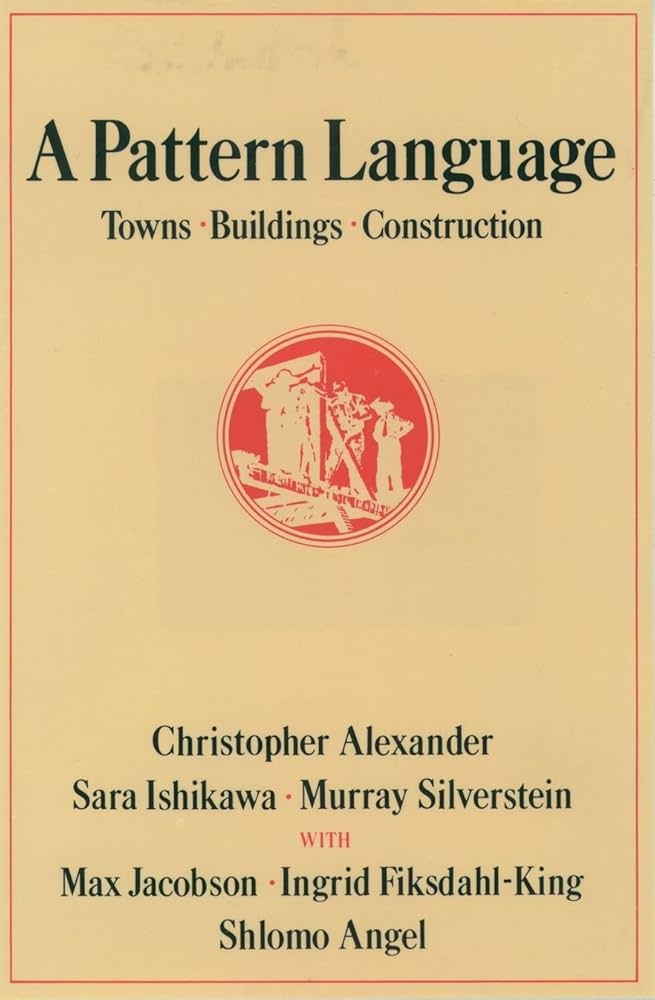
I had heard of Christopher Alexander in various different contexts, but what pushed me over the edge was listening to Brian Eno on the Ezra Klein podcast recommend ‘A Pattern Language’ as one of his three book recommendations. He’s gifted it over 50 times apparently.
By chance, I walked by it in the large Foyles in London, tucked away in the highest shelf in the architecture section.
It captured me instantly.
More of a book you flick through, then read from cover to cover. It’s a collection of design aphorisms and ‘patterns’ that are practical.
Place the main part of the kitchen counter on the south and south-east side of the kitchen with big windows around it, so that the sun can flood in and fill the kitchen with yellow light both morning and afternoon.
Never furnish any place with chairs that are identically the same. Choose a variety of different chairs, some big, some small, some softer than the others, some rockers, some very old, some new, with arms, without arms, some wicker, some wood, some cloth.
It goes from the large scale (designing cities) to the small scale (‘a front door bench’).
This book reminds me of the importance of design - intentional creation to support actions. Beauty is functional. It affects your behaviour.
People cannot be genuinely comfortable and healthy in a house which is not theirs. All forms of rental – whether from private landlords or public housing agencies – work against the natural processes which allow people to form stable, self healing communities.
So many different topics are explored :
- The problem of urban sprawl. “The artificial separation of houses and work creates intolerable rifts in people’s inner lives”
- The importance of decentralisation, small communities, subcultures. “Do what you can to establish a world government, with a thousand independent regions, instead of countries”
- Old people everywhere. “Old people need old people, but they also need the young, and young people need contact with the old”
- “The nuclear family is not by itself a viable social form”. Human society for the majority of its history was based on the extended family – three generations living together, aunties, uncles, grandparents, cousins - in close proximity. The nuclear family is not viable - “it is too small”. It takes a village to raise a family. One needs a multitude of differing experiences from uncles/aunts/grandparents/parents. He mentions ‘Island’ by Aldous Huxley, one of my favourite books. “How many homes does a Palanese child have?”, “About twenty on average”. We need a mix of communal and individual spaces and influences.
- The importance of play for children, and making those spaces possible in modernity. “If children don’t play enough with other children during the first five years of life, there is a great chance that they will have some kind of mental illness later in their lives”
The whole book is full of wisdom. A few random sentences to demonstrate the variety of places it goes.
Wherever there is a sharp separation between residential and non-residential parts of town, the non-residential areas will quickly turn to slums"
If children are not able to explore the whole of the adult world around them, they cannot become adults. But modern cities are so dangerous that children cannot be allowed to explore them freely.
The suburb is an obsolete and contradictory form of human settlement
- “The human body does not wear out with use. On the contrary it wears down when it is not used”
Always place building to the north of the outdoor spaces that go with them, and keep the outdoor spaces to the south. Never leave a deep band of shade between the building and the sunny part of the outdoors.
Give each member of the family a room of his own, especially adults. A minimum of one’s own is an alcove with a desk, shelves and curtain… In all cases, especially the adult ones, place these rooms at the far ends of the intimacy gradient – far from the common rooms.
Children love to be in tiny cave-like spaces
There is abundant evidence to show that high buildings make people crazy
I wonder what Christopher Alexander would have to say about smartphones. I asked Claude :
PATTERN: THE PHONE IN ITS PLACE
The smartphone promises connection but often delivers fragmentation. It follows us everywhere, interrupting the natural rhythms of work, rest, conversation, and solitude.
Therefore:
Create deliberate physical territories for your phone - places where it belongs and doesn’t belong. Keep phones out of bedrooms (they destroy the sanctuary quality of sleep). Create phone-free zones at dining tables (to preserve “communality of the table”). Designate a specific spot near the entrance where phones rest when you’re home - visible enough not to create anxiety, but separate enough to allow full presence.
Design your digital life with the same care you’d design a room: with thresholds, boundaries, and intentional circulation patterns. Let the phone serve the space and activity, not dominate it.
This pattern connects to: “communality at the table,” “marriage bed,” “sequence of sitting spaces,” “intimacy gradient”
I would add
- Always keep your smartphone on do not disturb. No push notifications. The phone is a tool that you have control over, not something you are subservient to.
- Although the phone can do many things, there is a value in single purpose items e.g. books, a camera, a music player
This book made me think about my early childhood in India. It ticks so many of the boxes that C.A talks about. We even made little caves out of blankets. There were communal spaces, private spaces, an ecosystem that nurtured children. Elderly, with the young, with the middle age.
We have to recreate this.