the importance of rituals

Routine is disguised ritual
David Whyte
Recently, a lot of my time has been spent walking in silence, taking in the sights and sounds of the city, the occasional bird song mixed in with the regular police sirens. It’s been a few months living in London and I’m enjoying the novelty of everything. On weekends, I’m out of the flat 95%+ of the time, and even if there is nothing planned, I just pick a direction and walk and see what comes up.
It’s insane to me how much culture, diversity and art exists. London has been described as a lonely city, but I’ve found that there are infinite number of communities to join, it’s just about scheduling it on the calendar.
Even with so much novelty however, you can’t help but fall into a routine. Working a 9-5 job provides this automatically, but even the smaller routines of which coffee shops you visit, or the activities you do or the restaurants you visit.
This made me think about ritual. I was having lunch with my sister/brother in law (soon to be), and joked that we seem to be having lunch every Sunday now. I realised it’s a ritual, and it’s not a bad thing to call it that. It’s nice to have a regularity to your week, actually scheduling it on the calendar.
I thought about what other rituals I have, and what rituals I would like to have.
I used to regularly go climbing on Tuesday and Thursday evenings with the same people. I’m coming to realise that this was a ritual. It wasn’t about the climbing, it was just about the regularity of coming together. In our atomised digital world, we are losing meeting up in third spaces. I would like this back.
I want to try shape my life to have these social rituals. Some ideas : weekly climbing group, running club, yoga. It needs to be low effort. This is where physical proximity matters a lot for cultivating friendships and relationships.
Internal rituals
I was thinking about the unseen internal rituals one has. Call them habits if you want another word. How do you routinely/habitually use your mind? What kind of thoughts do you think? What kind of feelings do you allow to surface and how do you judge this? Where and how do you direct your attention?
We know that ‘neurons that fire together, wire together’. Repetitive action forms deep grooves in the mind where what was once deliberate action becomes automatic and often unseen.
Examples of internal rituals flow through our daily lives: practicing gratitude for one’s circumstances, mindful self-talk and esteem, cultivating a sense of agency, and the way you greet someone - wishing them well internally with compassion for others.
I suppose the question is : what kind of person do you want to become?
Vacuuming
On retreats, you are usually given a small task that you spend 1 - 1.5 hours a day doing. On the last retreat I went on, I was given vacuuming. I hate vacuuming. It’s a close second to ironing.
But I decided to really bring my practice to the act. On the first day, I realised that I never actually paid attention when hoovering (probably never in my entire life unto that point). I always saw it as something to get ‘done’ rather than a process that one can bring their attention to.
One image that kept on coming up for me, was that of Hirayama, from the recent film ‘Perfect Days’. The level of care and attention he brought to cleaning toilets in Tokyo was that of a zen monk.
I tried to embody this level of attention to hoovering and mopping the floors. By the end of the retreat, hoovering was pure bliss. I made something mundane and previously disliked, into a beautiful act of creativity and care all through the attention brought to it. This attention to the mundane opens doors to seeing transitions everywhere in our lives. Each moment can be a threshold, a chance to pause and notice.
Thresholds
Routine’s can serve as a boundary between moments during the day. Coming from a long day of work, what do you do? What habits do you have to wind down?
Even something as simple as when you walk through a door- you can create a ritual of this. I’m reminded of walking through the torii gates in Japan, it’s customary to bow. The bowing is just a ritual; a gentle reminder to pay attention. And in the act, you are transformed.
Daily anchoring rituals are powerful if noticed. There was this rule in the recent Zen retreat that when one leaves the zendo, you walk such that your right foot is the first to touch the ground when exiting. Just a small reminder again. Pay attention.
Just existing, I find these thresholds everywhere - my daily train commute feels different each time if you pay attention. Entering the train can be a moment of transition rather than just dead time. These thresholds mark the boundaries between different worlds, different versions of the day.
Similarly you can do the same with other actions. When pulling out your phone, what goes through one’s mind? Most times, it’s automatic - a hand reaching for the pocket before the thought even forms. But what if this too became a threshold? A moment to pause, like bowing at a torii gate, before crossing into the digital world. A breath, a thought, an intention.
These modern thresholds might not have the weight of centuries-old traditions, but they can serve the same purpose - creating space between moments, reminding us to notice the transitions in our daily life.
Routine is the way we worship fully at the altar of the timeless. Routine is the way we step down from what is absolutely extraordinary into the miracle of an ordinary day and an ordinary hour. Routine is disguised ritual.
David Whyte
lazy susan method
I was listening to a [podcast with David Eagleman (neuroscientist) and Rick Rubin.
In it Rick Rubin asks Eagleman how has managed to maintain such a prolific output over the years (multiple books, research projects, non profits etc)
Eagleman says he uses what he calls the ‘lazy susie method’.
It is where he works as much as he can on a specific project, until he can’t, and then just switches to something else and works on that, until he can’t etc
I loved this. It’s something I want to emulate for a few reasons
- It keeps things interesting. Having multiple projects/identities/hobbies/interests is more fun
- The combinatorial knowledge gained from working on disparate topics is greater. Work from one field adds to work in another
- It prevents burnout. Putting all your eggs/identity into one basket/project/identity is risky.
- When you hit a brick wall in one domain, you continue to progress in another
we live in time
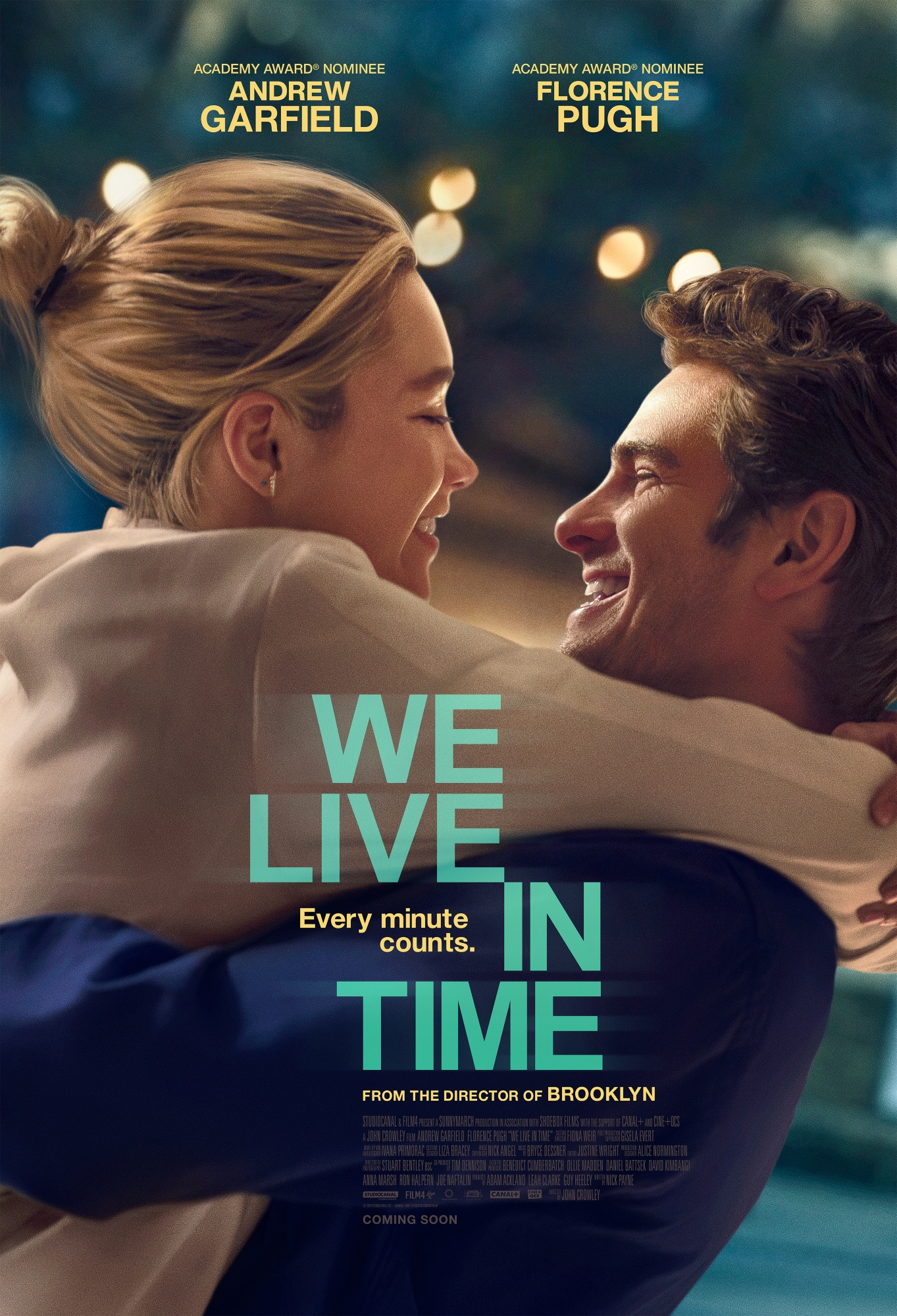
‘We Live in Time’ is a story about the relationship between Almut and Tobias, played by Florence Pugh and Andrew Garfield. It weaves together moments from their relationship in a non-linear narrative, exploring themes of love, sacrifice and the ephemerality of time.
I liked this film, but I didn’t love it.
Florence Pugh and Andrew Garfield and their on screen chemistry made is a good film, but I think the script was slightly lacking which I think was largely due to the non-linear narrative style.
I understand that was part of the theme of ‘We Live in Time’ - to focus on moments in time that are now, but the consequence was that the story felt like it lacked a narrative arc.
For example, if Almut and Tobias had a huge argument, we would know the outcome (because we had seen it before). If there was conflict introduced about whether they wanted kids or not, we already knew the outcome.
And unfortunately as humans we like narrative arcs. We like to see character development, tension, resolution and conclusion.
To be honest, I think it didn’t tackle the heavy topics that were introduced that well : grief, illness, conflict in relationships, whether to have kids/no kids, balancing personal goals/ambition with family life.
Spoilers : for example we see Almut, in this life phase, battling a recurrence of her ovarian cancer. She is on chemotherapy and has been lying to Tobias and secretly taking part in a competitive cooking competition, the finals of which is on their planned wedding day.
Ultimately we see Tobias give up that wedding day to go to Almuts cooking competition with their daughter. A huge sacrifice that I thought they would address. But it was just glanced over.
Enough disparaging of the film. I liked it! But to me it’s an example of an ‘ok’ script being elevated by excellent acting. I found that I was crying and laughing. I didn’t expect it to be a funny movie, but it was.
I think the idea of the non-linearity of the movie was to take each moment in time as it is. The nature of time and the irrevocable mysterious nature is a difficult subject to tackle, a deeply spiritual topic. I’m reminder of the poem ‘Time’ by David Whyte in his new anthology, which explores this. If you can, go read it. A few of my favourite lines :
Time is not slipping through our fingers, time is here forever, it is we who are slipping through the fingers of time
The entrance into time is always the threshold where we are asked to loosen our grasp on our previous, fearful understandings. Love is time unanchored and let to be fully itself where the hours are rich and spacious with anticipation and the sudden sense that there is no immediate horizon to our possibilities
The letting go of time is a doorway to love.
Final thoughts
“We Live in Time” is a film that reaches for profound truths about love and time, even if it doesn’t quite grasp them all. While the script sometimes struggles under the weight of its ambitious structure and themes, the powerful performances by Pugh and Garfield create moments of genuine emotional impact. It’s a film that, like time itself, contains both beauty and imperfection, moments of brilliance and missed opportunities.
The result is a movie that, while not perfect, leaves you thinking about the nature of time and relationships. It reminds us that every moment - whether joyful or painful, significant or mundane - is part of the larger tapestry of our lives. In this way, perhaps the film’s fragmented narrative succeeds in its most fundamental goal: showing how we truly live in time, not as a linear progression, but as a collection of moments that shape and define us.