perfect days and the beauty of analogue
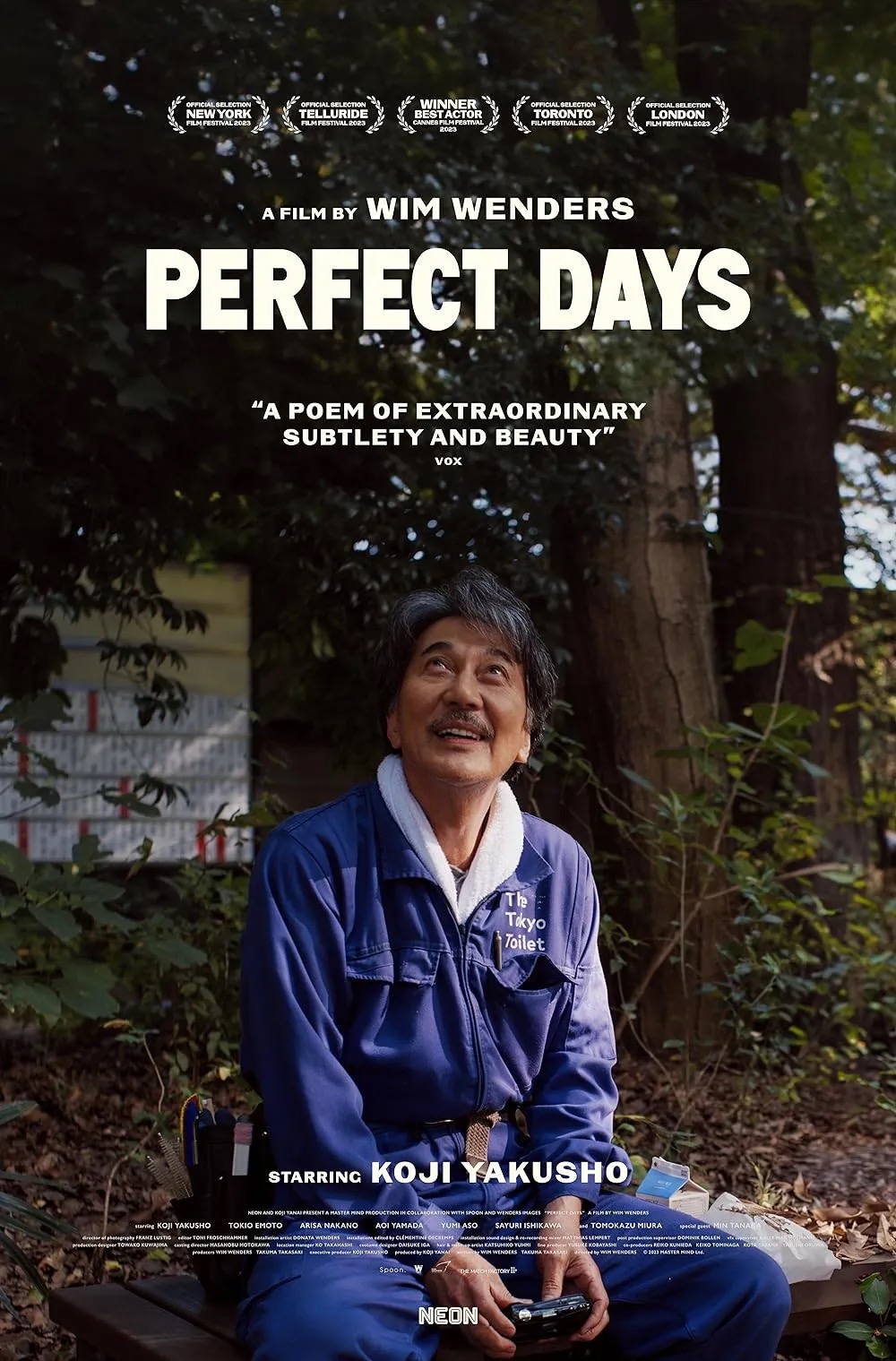
This film is beautiful. A meditation on attention, beauty and the value of simplicity.
The film follows the protagonist ‘Hirayama’, a public toilet cleaner working in Tokyo. It shows his daily routine, how he gets up, takes care of his plants, gets ready for the day, commutes to work in his small van listening to analogue cassette tapes, and then spends his working day diligently cleaning toilets in Shibuya and across Tokyo. He finishes his work, frequents the same restaurant, visits a secondhand bookshop and buys a single book, returns home, reads his single book and goes to sleep.
There are many themes within this movie, all hidden in-between the lines (with very little dialogue in the movie). It is a very Japanese way of expression; the silences hold all the truths.
However, one theme that resonated was the value of analogue and what is represents.
By analogue, I mean the fact that Hirayama would read books, listen to cassettes, enjoy taking film photos and develop them. More importantly, it’s the attention that analogue affords.
The easiest way to start to explore this is to look at the modern day human (me) versus Hirayama.
The modern day ‘digital’ human :
- I would get up, instantly check my phone for the messages I have received. Check instagram, accidentally get sucked into a vortex of random meaningless posts. Gain enough sentience to realise this is happening, or look at the clock to break the trance
- Get ready whilst listening to a podcast that I’m not truly absorbing
- Commute to work listening to an algorithmically curated selection of music, that I skip half the time because I’m not instantly captured in the first few bars
- When I get the time to read, I flick between books on my kindle, never truly committing to finishing a single book. I often glance over entire paragraphs, not truly absorbing them.
- When I decide to take photos, I take 10 of the same photo, and decide which one I like the best, and edit it to the point where it is distorting reality
- If I go for a walk, it’s always with headphones. Never in silence. Always a podcast or a conversation so that any signs of loneliness or isolation are buried deep down.
- If having a conversation with a friend, your phone buzzes and your attention slips away momentarily, but perniciously erodes any feeling of true conversation
- If you ever sit down and try to write, you get sucked into the internet. Or you stick to writing stupid listicals or trite posts. You eschew fiction and long complex topics for the surface level.
- If you want to seek knowledge, you google everything. You never sit and try to figure it out on your own. You seek instant gratification.
- If you ever consume a piece of media, it’s always with two screens; the big screen and the little screen.
- When you eat any food, you have to have something playing lest you accidentally take the time to taste your food.
- You distract yourself with Amazon purchases, thinking that the next thing you buy will cure the problems you have.
Take Hirayama:
- He wakes up without an alarm clock to the sounds of birds outside
- Every morning, he takes the time to carefully spray his houseplants
- He gets ready in silence; absorbed in the mundane daily ablutions
- He owns few things. He takes care of the few things he owns
- On every morning commute, he browses through his small collection of cassettes and listens to one from the beginning to the end.
- At work, he diligently cleans the toilets devoting his full attention to the work. He occasionally pauses to look at the light filtering through the trees in the park.
- He eats lunch on the park bench, taking photos of the trees. He spends time visiting the photo shop to develop these later on in the weekend
- He visits a second hand book shop where he buys a single book at a time, which he reads before bed. Once he finishes the single book, he adds it to his bookshelf.
- He eats his dinner at the same restaurant, taking his time to enjoy the food.
- On weekends, he visits the onsen/bath-house and unwinds.
There is much more to Hirayama’s life below the surface which the movie hints at, so I don’t mean to say that it’s all joy.
But the attention that is brought to life, results in joy with the mundane.
The quality of your attention, determines the quality of your life.
The modern human lives a life of fractured attention. Hirayama in contrast lives a life in devotion to attention.
This is what I feel analogue hints at. The nostalgia and aesthetics are valuable, but what they really represent is a way of paying attention that modern day digital devices do not provide us with.
A single pointed attention. Where we complete things, we finish books from start to finish, listen to songs without skipping, pay attention to the mundane. Where we are comfortable with some boredom.
This is essential because in losing this ability, you lose the ability to pay attention to your life. To the beautiful inexorable unfolding. Seemingly life seems to be a set of problems that one must overcome before truly enjoying it, or a way of distracting oneself to avoid facing it head on.
Once I’m done with this [pesky problem] then I can start working on [important thing]. Joy is found there, not here.
Perfect days is the perfect reminder of what matters. It is not the external but the internal. The way one directs their attention. Everything you seek is right here.
29
I’m 29 and although it’s not yet the big ‘3 0‘—in some respects, it practically is. Here are some pithy aphorisms and ideas to ponder.
1. When you take care of the small things, the big things tend to take care of themselves.
Clean your environment. Exercise. Eat well. Schedule time for dinner/lunch with friends. Make time for your hobbies.
2. Your environment sways your decisions and your actions
“The proximity of a desirable thing tempts one to overindulgence. On that path lies danger” — stealing a quote from Dune.
3. Socialising as an adult is simply scheduling it on the calendar
Make an effort to schedule activities, get-togethers, dinner parties. Learn how to be a good host.
4. Don’t have a single defining identity
Putting all of your eggs in the basket of ‘work’, ‘social life’, or ‘hobbies’ is risky. When one inevitably falls by the wayside, your whole world can shatter.
5. Competition destroys play
The great Chinese sage Tranxu puts it marvelously: “When the archer shoots for nothing, he has all his skill. When he shoots for a brass buckle, he is already nervous. When he shoots for a prize of gold, he goes blind. He’s out of his mind. He sees two targets. His skill has not changed. But the prize divides him. He cares. He thinks more of winning than of shooting. And the need to win drains him of power.”
6. Art is essential
You can’t let your creative soul vanish into the busyness of the day. You must make time to write, photograph, paint, sing, dance, stitch, sketch, or play. Not to be ‘good’ either. Although that can be a project. Make art for the sake of it. Show no one. Show everyone. Detach yourself from the outcome. Or attach yourself and accept some level of suffering. But whatever you do, create (preferably with your hands).
In the act, a transformation occurs, not in the world, but in yourself. The lens through which one views the world is altered. You become more joyful, and interestingly, you’ll find that the world simultaneously becomes more joyful.
7. Maintenance is essential
Objects require maintenance. People and relationships require maintenance. Otherwise, they break down.
Take care of things and things will take care of you. — Shunryu Suzuki
8. Stillness is essential
For a delight in bustling about is not industry – it is only the restless energy of a haunted mind. — Seneca
Travel is only as useful as the stillness we are able to bring to it. It is only in the solitude, the silence, that we can create meaning out of experiences.
9. Beauty is essential
Surround yourself with people, objects, and activities that bring you joy. That you find beautiful. Beauty is not necessarily in objects, it’s in the way one looks. You have to slowly remove the barriers that prevent one from realizing beauty right here.
Some people look for a beautiful place. Others make a place beautiful.
10. Relationships are essential
11. Love is essential
Love is just a special form of attention.
12. Attention is essential
Shut off your phone. Go for a walk in the park alone or with a friend.
Seek immersion, not stimulation.
13. You can’t do everything
Every man is born as many men and dies as a single one. — Heidegger
14. Grief is universal
Sons have been losing mothers for centuries and will continue to do so.
15. Loosen the grip
Sit and listen. Pay close attention.
A continual process over the past decade. We are so attached to our preconceived notions of how reality should be. Loosen the grip.
Hawaii 2024
A family trip to Hawaii