deloads and keeping the flywheel spinning
Long term consistency trumps short term intensity
Bruce Lee
There is a concept in training called ‘periodisation’.
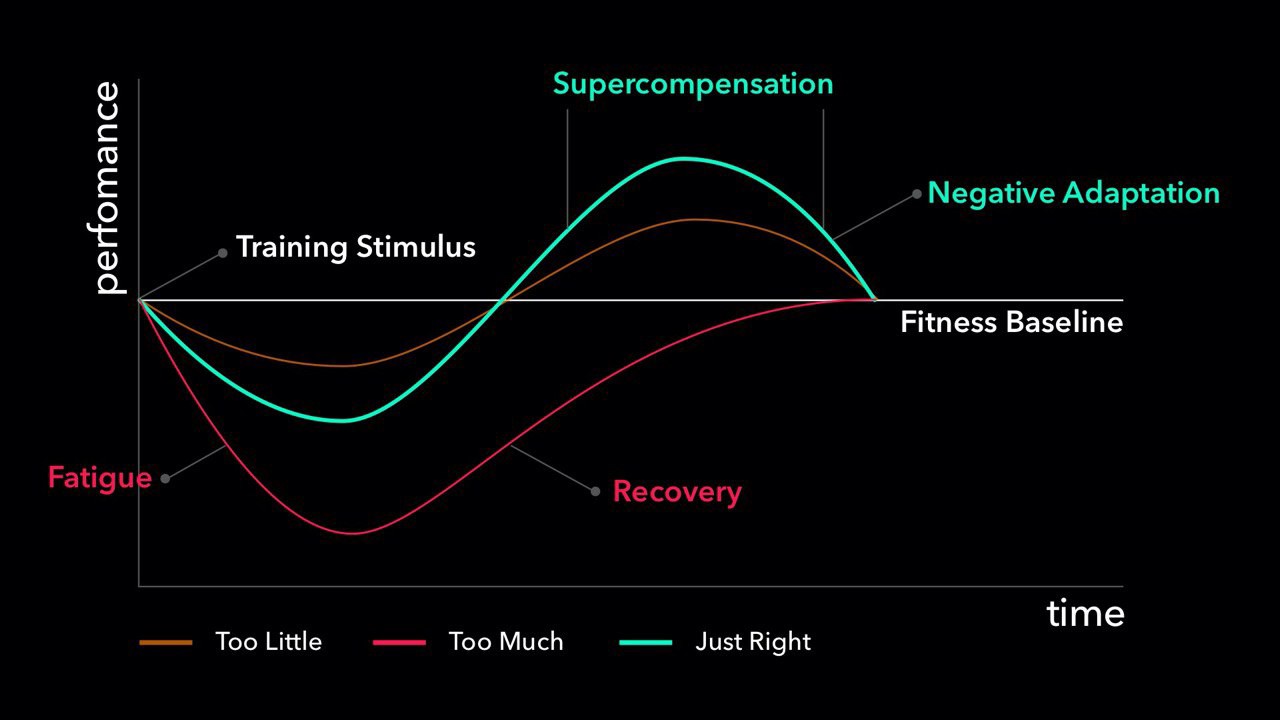
Simply put : You can’t keep adding 5lbs to the bar and expecting it to go up. You don’t make linear progress at a certain point. Therefore the ‘way’ you train becomes crucial.
You have to take regular ‘deload’ weeks where you reduce the CNS fatigue and stress, and allow the body to recover. In fitness, this is normally every 6-8 weeks depending on the program.
Therefore the trajectory of improvement then looks like this.
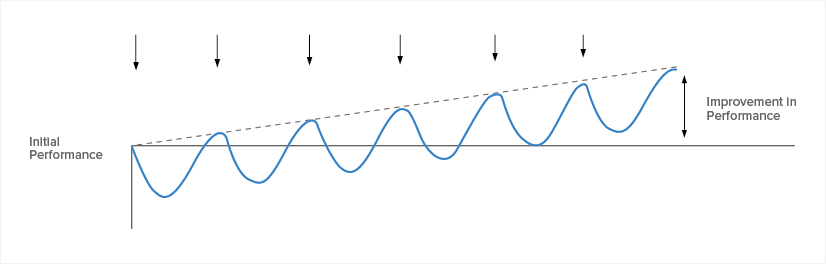
If you intend to train long term (which you should), then deload weeks are non-negotiable. All intermediate-advanced-elite athletes know this. Sub-maximal training is crucial to getting to that stage.
But the concept of deload weeks is generalisable to more than just fitness.
On an intellectual level, you can keep burning the candle at both ends. Short term intensity is required, but so is rest. This is why people ‘burn out’.
For ‘Type A’ people, putting the foot on the accelerator is easy. They’ve been doing it their whole lives. Intuitively it makes sense. More time, more work, more intensity means better results.
In the short term this is true. But if you are playing long term games, this is the wrong approach.
Sprint, Rest and Reassess
Progress in any endeavour is not linear. Train smart. Rest. Reassess and Sprint.
In ultra-long term endeavours - think mastery in a skill such as writing/programming/music. You want daily consistent work.
The author Murakami advises that you stop writing at the moment you know you could do more. Then the next day you are still energising to continue writing. Therefore the flywheel keeps on spinning.
TLDR: Submaximal training allows for consistent long term progress
the art of gathering [book-review]
Priya Parker wrote an excellent book called ‘The Art of Gathering’.
‘How we meet’ is a vital human experience, but too often we don’t give it enough thought.
We spend our lives gathering, with family, friends, in school, at weddings, business meetings, class reunions, dinner parties, sports groups, religious ceremonies, and at the end of our lives, our loved ones gather at our funerals.
We all intuitively know that gathering is important. We can look back and remember times that ‘we gathered well’ and times that weren’t so well. The awkward dinner party where one too many guests were invited, or the social where you weren’t very social.
More and more, we are unhappy with the way we meet. Going to conferences, work meetings or drinks parties, we find that the host has rarely given thought to how guests will connect, why they are meeting, and what they will take away.
There are ways that you can ‘gather well’.
1. Know why you are gathering
You should be explicit to yourself in why exactly you are gathering. ‘Think less about the what, and more about the why’. For example:
Take a birthday. If your ‘why’ is to surround yourself with your loved ones, then invite a small group and have an intimate dinner. If your ‘why’ is to reconnect with old friends and colleagues- then invite a larger group for a barbecue.
Knowing why you are gathering, is the starting point for the rest of your decision making
2. Good gathering requires exclusion
Once you know the underlying purpose of the gathering, you can choose who to invite. And more importantly, who to exclude.
Include only people relevant to the gathering. If you intend to spend time with your school friends, and the intention is to ‘catch up’ - don’t invite a work colleague. (Unless the intention is to meet new people).
The ‘more the merrier’ is not true. How many people depends on the ‘reason why you are gathering’.
3. Don’t be a ‘chill host’
An engaging and generously authoritative host will always deliver than a laid back host
Hosting is a skill. It requires attention and effort. An abdication of power as a host often fails guests rather than serving them.
You have ‘power’ as a host. The author talks about a time she was at a housewarming party, and there was a lull after dinner. The author suggested that they play a game of ‘werewolf’ but the host wasn’t sure that ‘everyone’ would enjoy it. They were unwilling to exercise their power. As a result, the moment passed and the party broke up in an unsatisfying way.
Another example was where the author facilitated a conference with the purpose being to bring together people involved in the agricultural industry. There were 120 people who didn’t know each other. So she utilised her power as a host, and asked that every attendee get up and move to a different table after each speech. Initially it seemed like an imposition, but ultimately at the end of the day, everyone was grateful. This simple rule facilitated the reason ‘why’ they were implicitly gathering - to form new connections. By being at the same table the whole time, they wouldn’t fulfil that purpose.
4. Having rules can be freeing
An addendum to the above. Depending on the gathering, you can set rules as a host. Exercise that power.
Rules can allow for playfulness and meaningful gatherings. Examples include : no phones, arbitrary mixing rules at a social.
5. Introductions and Starts
Prime people before the event of what to expect. Give them a little synopsis. If hosting a dinner, let people know who is coming, what you will be serving, any activities planned, and roughly when it will start and finish.
Then when they arrive, acknowledge this explicitly. Make introductions if needed. Serve them food/drinks. Show them around if a dinner.
6. Encourage authenticity
We all crave authentic interaction. I’ve been in situations where the conversation barely left the superficial, and then led to the group just sitting next to each other on their phones. Most gatherings in university were disappointing in my experience.
How can you encourage authenticity? This is another intention you must hold as a host, and there is no one way. You cannot demand authenticity, but you can create an environment which fosters it.
You can make guests feel comfortable. You can be vulnerable yourself. You can ask for stories about other people’s lives. How to tell stories is a skill itself.
7. Endings
Have an explicit ending. The peak end heuristic states that we remember the peak and the end of any experiences the most.
Therefore ‘how things end’ matters a lot. Make it explicit- if for example hosting a dinner party, you can let guests know that they can leave if they want to, but if they choose to stay they can retreat to the living room etc.
8. Create rituals
Ritualised and regular meet ups are powerful. Try to commit or create a group around a shared purpose. Then aim to meet regularly. This is how you form deeper bonds.
Examples
- Sunday brunch
- Coffee and climb
- Evening walk
- Sports clubs
Conclusion
Be the host. Don’t wait for others to open their door. Open yours.
regret
People regret inaction more than action
- Consistently- people regret not doing. Example : people regret NOT asking out someone, rather than asking out someone.
- Actions can be undone. Inaction is harder.
Daniel H. Pink describes 4 consistent categories of regret seen across different ages and cultures.
1. Foundation Regrets
‘If only I’d done the work’
Examples
- Not taking care of health
- Not studying harder in school
- Not saving enough money
2. Boldness Regrets
If only I had taken the chance
Examples
- Asked out guy/girl
- Spoken up / spoken my mind
- Starting a business
- Travel
3. Moral Regrets
If only I had done the right thing
Examples
- Infidelity
- Lying
- Bullying
4. Disconnection Regret
If only I had reached out
Examples
- Not connecting with an old friend/colleague
Getting over regret
You have to reframe and disclose the regret. The main way is to say
Next time - I will do X : Specific action.
For example - if struggling with boldness regret - be specific - and say next time I would be more direct and ask that person out.
Personal
The two most stand out for myself depend on the stage in life.
At university : Boldness regret. Should have taken more chances
Currently : Disconnection regret. I should reach out to more people. Act as a host.
Conclusion
Aim to minimise regret. You will regret inaction rather than action.
I’d rather regret the things I’ve done than regret the things I haven’t done