caffeinated consciousness
TLDR: I love caffeine. : Notes on Michael Pollan’s book - specifically the Caffeine chapter
I recently listened to Michael Pollan talking about his new book ‘Your Mind on Plants’.
In it, he discusses three main plant substances : Opium, Caffeine and Mescaline.
This is a summary of the ‘Caffeine’ section - a drug 90% of the human population consumes daily, including me. We think we are in ‘vanilla’ consciousness, but our default is actually caffeine infused consciousness.
1,3,7-trimethylxanthine : my first love
World’s most used psychoactive compound
90% of the world consumes caffeine in some form. In fact it is the only drug we routinely give to children (in the form of soda).
Most don’t even think of it as a drug, because it has become so ingrained into daily routines. Our baseline state of consciousness is caffeine fuelled.
The Plants
Caffeine is found and consumed primarily from two sources
- Coffea ‘bean’
- Camelia sinuses leaf (tea)
It’s miraculous how these two plants managed to produce a chemical that somehow binds to a receptor in the human brain and alters the state. Clearly not the intention of the plants. They now command a vast infrastructure where we move these leaves all around the world, cover huge swathes of land- all for the sole purpose of infusing in water and then throwing it away. It’s pretty weird.
These plants produce caffeine as a pesticide for defence against predators, because at high doses caffeine is lethal to insects. It’s bitter flavour also discourages them from chewing on the plants.
You can see the effect of caffeine on insects: For example : NASA conducted a famous experiment in 1990’s where they fed psychoactive substances to spiders.
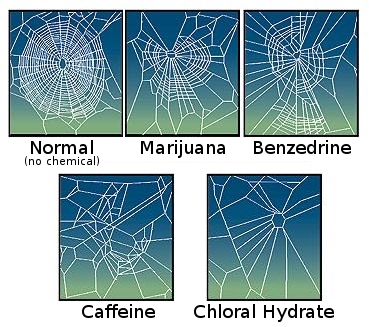
The caffeinated spider was pretty useless. The insects are effectively neutralised.
Why don’t the plants just produce pesticides that kill the insect? Why make it confused. This is because killing it, would then select for resistant members of the population.
History of Caffeine
Caffeine only arrived in Western Civilisation in the 1600’s! Pretty late.
All apparently in the same decade (1650’s) in England.
Coffee was in East Africa a few centuries prior- and was thought to be discovered in Ethiopia in AD 850 by a goat herder. He noticed his goats would be hyperactive after eating berries from the Coffea Arabica plant. It was then traded across Arabian Peninsula- used by Sufi’s as an aid to concentration. Tea is older than coffee - discovered in China since 1000BC - and was used by Buddhist monks.
Coffee houses sprang up in the Arab world - more than 600 of them in 1570’s Constantinople. These were centres of gathering, news, gossip and performances.
Pollan notes that this period coincided with flourishing in science, technology and learning. Similarly in China, the popularity of tea in the Tang Dynasty coincided with a golden age.
He posits this may be because : people no longer had to drink alcohol. Prior to coffee/tea - people in Europe mostly drank alcohol instead of water - as it was safer. It was fermented. Therefore most people lived a drunk existence - from waking up to sleeping they drank alcohol.
The advent of coffee/tea - meant that they now had a reason to boil water and drink hot water. This killed any microbes and was safer than drinking plain water.
The first coffee houses popped up in the West in Venice 1629- and then in England in 1650’s. “Within a few decades, there were thousands of coffeehouses in London; at their peak, one for every two hundred Londoners”.
Coffee houses were a venue for exploration, conversation and a place where different classes could mix (more reputable than taverns). They were “often referred to as ‘penny universities’”. Apparently each coffee house attracted a niche e.g. scientists would congregate at the ‘Grecian’ which became associated with the Royal society. “Literary set gathered at Will’s and at Button’s in Covent Garden”.
Pollan explains that coffee may have significantly contributed to Capitalism in the West- mainly through allowing humans to escape the rhythms of the sun. It allowed for night shift / shift work : owners would institute coffee breaks. It’s pretty weird - your employer giving you time off specifically to consume a drug. The advent of tea and coffee also meant that sobriety became more common, and this may have also led to increases in productivity. Coffee houses were beds for liberal ideologies and good conversation, and may have had a significant contribution to enlightenment values.
MOA of Caffeine
Caffeine produced by these plants, blocks a receptor in the brain that binds the neurotransmitter ‘Adenosine’.
Adenosine when it binds- has a “depressive and hypnotic (sleep inducing) effect on the brain”. It varies throughout the day- so that over the course of a day Adenosine rises in the bloodstream making us sleepy. ‘Sleep pressure’. Along with Cortisol, it is responsible for regulating our sleep-wake cycle.
Caffeine has several indirect effects too : increasing adrenaline, serotonin and dopamine. The Dopamine release is responsible for the mood enhancing benefits and also the potential addictive nature.
Caffeine is a vasodilator. It is also a mild diuretic. It temporarily raises blood pressure, and relaxes the smooth muscles of the body (laxative effect).
Coffee and tea are large sources of antioxidants. You can also gain these from drinking decaf.
Largely, the scientific research has found caffeine beneficial as long as consumed within moderation. A recent BMJ met analysis found it reduced all cause mortality, reduced the risk of several cancers, and Alzheimers.
Caffeine decay
Pollan then does tackle the negative effect of caffeine.
The quarter life of caffeine is around 12 hours. This means that 25% of caffeine in coffee consumed at 11am, is in your system at 11pm. Matthew Walker (Why We Sleep) suggests that this may be enough to impair deep sleep which is vital for memory formation and several other facilities.
Why We Sleep tackles many of the negative consequences of poor sleep in our society. It is worth a read, but also has several problems as detailed by Alexey Guzey.
Walker suggests our sleep crisis is caused by
- Screens
- Alcohol
- Pharmaceuticals
- Work schedules
- Noise and light pollution
- Anxiety
- Caffeine
Pollan does mention that :
“In fact, none of the sleep researchers or experts on circadian rhythms whom I interviewed for this story used caffeine”
Abstinence
Pollan decided to quit coffee for a period of a few months to assess his relationship to the drug. The way he writes about it is hilarious.
The main benefit he found was improved sleep. But he recounts his 3 months abstinence as harrowing. How was he going to fuel the writing of the chapter on caffeine, without caffeine. The very chapter was endangered by the lack of the drug he was writing about.
He finally has his first cup after 3 months- and describes it as euphoric. Almost psychedelic. I know exactly how this feels.
My experience
I’m addicted. Coffee really has a profound impact on my mental state (positive) , and sleep (negative). I sleep for a shorter duration, and wake up feeling like a zombie (until the 1st cup). This is largely on only 1-2 cups a day, all before 11am. I am quite sensitive.
Yet, as Pollan acknowledges, it has huge benefits. According to the studies, it has a range of positive outcomes (reducing risk of cancers etc). Beyond this, it fuels creation. I know I am compelled to either write/code/exercise/talk/think/read when I drink coffee. There is also the ritualised social aspect that goes back centuries, from Zen Buddhist tea ceremonies, to the coffee houses of London. That is invaluable.
Reading the chapter has made me realise, I should use caffeine more carefully. Pollan talks about how after his abstinence, he decided to use it only on Saturdays. This went well, until it slowly creeped up to twice a week, and now it sounds like he is back to the daily cup.
I think I will try a similar experiment, or at least switch to green tea. I’ve tried several times throughout my life to quit caffeine completely, yet I always come back. It’s a drug I’ve decided to become symbiotic with for several reasons : the social aspect, creation, the feeling, the ritual. But I will try and moderate its use.
Conclusion
- Quit caffeine for a while : you can never understand your relationship to a substance until you get off it.
- When you eventually go back to some form of caffeination - green tea has historically been the most sustainable for past you.
- Might be fun to review all the coffee and teas
indie-web
TLDR : This is an exploration of the indie-web.
The indie web is a community of people building personal independent websites to host their own data, rather than on centralised platforms such as Facebook, Twitter or Instagram. The principles :
Your content is yours – When you post something on the web, it should belong to you, not a corporation. Too many companies have gone out of business and lost all of their users’ data. By joining the IndieWeb, your content stays yours and in your control.
You are better connected – Your articles and status messages can go to all services, not just one, allowing you to engage with everyone. Even replies and likes on other services can come back to your site so they’re all in one place.
You are in control – You can post anything you want, in any format you want, with no one monitoring you. In addition, you share simple readable links such as example.com/ideas. These links are permanent and will always work.
My Reasons :
1. You own all of your content
You are in control. You can post whatever you want without moderation or monitoring. You are not beholden to an external entity. This is simply html (with some css, js) hosted on a server. I own the content.
2. Greater protection against content loss
These platforms will shut down, lose your data or block your account. Social media is not that old. I used to have a Facebook account when I was in my late teens/early 20’s. I shut that down because I wasn’t really using it, but accidentally lost a few photos/videos that I won’t get back.
3. Homebase on the internet
It feels like you are constructing a small wooden fort on the internet. I love this. My intention for this website is mostly :
- Facilitate a level of creativity. I love sci-fi, but writing is incredibly difficult. This is an incentive to write more.
- Record of becoming : I like posting about my outlook on life at a snapshot in time. For example, I wrote some advice to myself when I was 20 years old. Another one at age 25. I’ll likely do one at 30 years old. It’s a record of becoming and change.
- Articulate certain viewpoints. At least for me, I can’t express something cogently and logically without writing it down first.
- Portfolio/Journal for any projects. I’ve made several projects over the years, but I never really documented them. For example, I made a text based choose your own adventure game when I was 14. I’ve lost it! This is the same for multiple projects. This makes me slightly sad, so I am going to try document any projects I do (physical/digital) and keep a record.
4. Ownership/ Long term Project
You control how your website looks. It’s an act of creation. I find myself taking more ownership whenever I post on here, compared to Twitter. It’s not simply a passing tweet. I find that I try to post more thoughtful/longer viewpoints and opinions, even if it doesn’t always hit the mark. It’s a project I can keep running in the background of life without the addiction potential of mainstream social media.
You are also not being monitored. There are no adverts. No censorship. No terms of service. No mailing list.
5. Publish once, syndicate elsewhere (POSSE)
You can post on your website, and then redirect to it on other platforms. This allows you to still reach your family and friends.
PASTA : Publish anywhere, save to private archive. Automatically save a copy of whatever you post on social media so that it is under your control. For example : All my tweets, likes, bookmarks : get saved in Pinboard, and I have a local archive. Less vulnerable to site death. I can also archive any webpages I find useful, and then have a copy incase the original goes down.
Notes on Design
Conclusion
I’m moving away again from social media. This website will be an alternative.
Resources
striking thoughts
I recently listened to a 4 hour podcast whilst driving in Scotland about the life of Bruce Lee. He’s another one of those figures who has shaped a large part of my thinking.
Lee wrote Striking thoughts : a series of reflections on various topics.
This is inspired by Striking Thoughts. Condensed aphorisms as a guide. These are for myself as reference. Please disagree and examine yourself.
Words are fixed. Life is fluid. Examine your own experience because truth is a pathless land.
Work
- Escape competition through authenticity
- Wu Wei : How can you get the maximum results by putting in the least effort?
- Work smart (not necessarily hard)
- Action over words
- Operate within your circle of competence
- Follow your genuine intellectual curiosity
- Learn outside of your field. Having distinct subsections of knowledge is a man made construction. There is a unity of knowledge.It all inter-relates and mixes.
- Create a local net positive
Wealth and Fame
- You want to be creatively living an anonymous life whilst contributing to society
- Micro change > Macro change
- Assets > Expenses
- Compound interest is 8th wonder of the world
- Keep a budget.
- Don’t fall into lifestyle inflation / upgrading. Living below your means holds a freedom those who don’t can’t fathom
- Time is non renewable.
- Trade money for time and experiences.
- You need very little to survive
- Don’t play status games
- Watch your desires- Hedonic treadmill
Communication
- Simplicity > Complexity
- If you can’t explain it to a 5 year old, you don’t really understand
- Understanding > Memorisation
- If you have nothing to say. Be silent
- Be curious. Ask questions.
- Don’t force learning. Learn when you are into it.
- When people give you unwarranted advice, it is a reflection of their desires
- Praise specifically, criticise generally
- Don’t give advice unless it’s asked for. No-one likes being preached to. It gives the idea that you understand better’ (which you don’t)
- Ask other people for advice
- Treat people on a peer to peer basis rather than hierarchical
- There is something to learn from everyone
Learning
- Read books. 21st century is the best to live in in terms of access to information
- Read old books for old problems (how to be content etc)
- Watch YouTube for modern day (how to code)
- Every problem you have faced, much smarter people have written down
- Any person can learn from experience. Better to learn from the experience of others too
- Be into it. Don’t force. Curiosity is the driver
- Doing > Reading > Watching
- Reason from first principles. Chef rather than Cook in domains that are important to you
- Slow is smooth, and smooth is fast
- Treat life like a series of 5 year experiments. Life is long. Continue to learn
Nutrition and Exercise
- Nutrition and exercise have huge impact physically and mentally. Overwhelming evidence. Few rules:
- Limit/Avoid processed food
- Eat food, mostly plants, not too much
- Eat some meat, fish, not too much
- Avoid seed oils
- Lift weights / Calisthenics
- Strength without mobility is nothing
Modern Day Struggle
- Abundance of information. Information overload
- You have a limited bandwidth
- Don’t consume news. It has become entertainment. Not evolved to be constantly switched on worrying about the troubles in distant parts of the globe
- As with junk food, you have junk information. Don’t read junk
- Use social media actively rather than passively (i.e. create)
Habits
- We are habitual creatures
- Every intention, thought, action is born out of habit
- Unconscious habitual processes can cause harm
- Examples of habits : exercise, nutrition, outlook on life, peace, reading, creativity, your emotional disposition
- Do it every day.
- Motivation is overrated. Habit is underrated
- Compound interest is the 8th wonder of the world
- Have something that keeps you fit, something that makes you money and something that keeps you creative
- Better to act your way into a new way of thinking, rather than to think your way into a new way of acting
- Discipline is overrated : You don’t rise to the level of your expectation, you fall to the level of your training
- Long term consistency over short term intensity
Decision Making
- Choose the option that would make a better story
- If you can’t decide, the answer is no (for the big decisions - marriage, work, location)
- Choose the option that will lead to long term peace of mind. Short term may be uncomfortable
Honesty
- Be honest. Then you have nothing to remember.
- Even white lies. Lying is more prevalent than one thinks. Deeply harmful.
- Temper honesty with kindness
- Kind > Smart
Self Knowledge
- Observe your thoughts and processes.
- Meditation is a way to transcend thought
- Reflection and introspection (e.g through journalling) is a way to create adaptive thoughts/stories.
- Use both meditation and reflection.
Time
- Psychological time is an illusion
- Just thoughts about the past or the future being projected into the present
- Literally the only moment that exists it the present.
- All else is just projected into the present
- It is possible to be present and also plan for the future.
- Being present is about being aware of the mind in each moment.
- Accept. Life is a river of sensory information, largely up to your interpretation.
Identity
- Identifying with any sect/tradition/teacher is the start of unawareness
- We go round creating identities and cling to them e.g. I am a doctor/lawyer/, I am ugly/smart/stupid/funny/ I’m Hindu/Christian/Jew etc ‘I am an unchanging entity’
- Without realising it is all illusory. A story we tell ourselves.
- Then when the ‘image’ is not congruent with reality. You are hurt. The image is not reality
- The self is just an internal model.
- The illusory nature of the self can be seen through- non dual awareness.
Science
- Science and ‘Meditation/Introspection’ are the two sides of the same coin
- Science is an exploration of the physical world through observation
- Meditation/Spirituality is an exploration of the internal world through observation
- Both non -dogmatic
- Both require no ‘a priori belief structures’
- Both require a sceptical but curious mind
- Spirituality is sadly misunderstood, confused with religion or ‘mysticism’.
- What is spirituality? : observe your mind
Jealously, Comparison and the Rat Race
- We all admire people who ‘march to their own drum’
- What this means is ‘internal validation > external validation
- Comparison is the thief of joy
- Jealously disappears when one is playing against an internal scorecard
- Jealously : would you swap 100% your life with the other person? No
- It is no measure of sanity to be well adjusted to a sick society (paraphrasing)
- It all goes to zero in the end.
- Desire is suffering. Striving for the sake of accumulation is madness
- Enjoy the process rather than striving for the outcome
Relationships
- Quality > quantity
- Core values have to match up. Then all the small idiosyncrasies and differences don’t matter
- You react to an image of the other person that you have created, rather than reacting to the person themselves
- Empty your expectations and images.
- Love and attachment are different.
- Attachment is reacting to an image of the other person. It is expecting them to conform to this image, as a non changing entity
- Love is unconditional. Reacting to reality
- Don’t give advice, unless it’s asked for. No-one likes being told what to do
- When you tell others what to do, its more a reflection of your own desires
- When you don’t hold any images, all judgement ceases
- Treasure the time you have- it’s on loan
Grief
- Grief comes in waves. Rather than resist, be curious and look. What is it that causes pain? Potential futures. Reminiscing about the past.
- Time and attention are all you have. Allocate them well
- Be grateful for the time you have. Everything is on loan.
Regret
Top regrets of the old “I wish I didn’t work so much” “I wish I didn’t conform to others expectations” “I wish I spent more time cultivating relationships”
Regret is a thought, it is entirely your perception. You can reframe events so that you create meaning or suffer less.