thoughts on design
TLDR : A few musings on design that I aspire towards
Bad architecture is in the end as much a failure of psychology as of design. It is an example expressed through materials of the same tendencies which in other domains will lead us to marry the wrong people, choose inappropriate jobs and book unsuccessful holidays: the tendency not to understand who we are and what will satisfy us.” ― Alain de Botton, The Architecture of Happiness
I’ve been thinking about how to decorate space. Your external environment often ends up being a reflection of your internal environment, and as Alain de Botton puts it, we should aim to “mould the material world towards graceful ends”
This is a personal aesthetic that is individual, but I want to articulate what works for myself
biophilic design
This aesthetic involves integrating nature with the built environment. I could cite studies that show ‘happier’ people, but you don’t need this. Subjectively, one can tell that being surrounded by nature is inherently peaceful.
minimal
Perfection is achieved not when there is nothing left to add, but when there is nothing left to take away. Antoine de Saint-Exupéry
Minimalism can be described as an art style. I’m referring instead to a personal view where space is utilised effectively to create an illusion of more space. Not emptiness for the sake of emptiness
I like the Japanese use of space.
wood, glass, brick and high ceilings
I’m not a fan of modern architecture and ’new builds’. I like keeping the external aesthetic of a building intact and congruent with its surroundings.
My favourite materials : Wood, Brick, and enough glass for natural light
High ceilings to create the illusion of space
walkable cities
Having walkable cities tends to create a sense of community. It’s the opposite of urban sprawl
Examples : London, Tokyo, Amsterdam, Florence, Paris, Edinburgh. You can rate your preferences using this tool.
woods >
I would like to live in a large metropolis for part of my life (London, Tokyo, NY) But longer term, forests and mountains have a natural pull on me
planck vs chaffeur
Extension of my previous post on how doing anything great takes at least 10 years
Examining the difference between ‘deep knowledge’ and ‘superficial knowledge. Other ways of articulating:
- memorising vs understanding
- Recall vs relationship
- real vs pretend knowledge
Planck vs Chauffeur Knowledge
Charlie Munger recounted in his 2007 Commencement to the USC Law School:
“I frequently tell the apocryphal story about how Max Planck, after he won the Nobel Prize, went around Germany giving the same standard lecture on the new quantum mechanics.
Over time, his chauffeur memorised the lecture and said, “Would you mind, Professor Planck, because it’s so boring to stay in our routine. [What if] I gave the lecture in Munich and you just sat in front wearing my chauffeur’s hat?” Planck said, “Why not?” And the chauffeur got up and gave this long lecture on quantum mechanics. After which a physics professor stood up and asked a perfectly ghastly question. The speaker said, “Well I’m surprised that in an advanced city like Munich I get such an elementary question. I’m going to ask my chauffeur to reply.”
The story articulates the difference between superficial understanding and deep understanding. Max Planck understood the topic, whereas the chauffeur was simply able to repeat.
What is the difference?
understanding is relational
Understanding is based on building on prior concepts, and seeing how they relate to each other
understanding takes time
Going back to the previous post. To develop deep understanding within a field takes time.
you can apply the concept to other contexts
For example : in computer science, understanding abstraction as a concept can be applied to other fields. Or in chemistry, the concept of activation energy.
You can explain without jargon
knowing the name of something doesn’t mean you understand it
The ultimate test is the ability to explain it to a 5 year old. I love this video where a neuroscientist explains the idea of a connectome
How do you develop Planck knowledge ?
Chauffeur knowledge is not bad
Having a superficial understanding of a topic is not a bad thing
What is bad, is pretending to have a deep understanding and deceiving yourself and others
You are going to start off by having superficial knowledge. What is important is :
- Deeply learn the basics
- Build on top of these concepts
- Question
- Think Deeply About Simple Things
- Keep a beginners mind
- Don’t obfuscate with jargon
Imposter syndrome is part of the process
You’re going to start off as the chauffeur.
In fact in the start you’ll think you understand something deeply (Dunning Kruger)
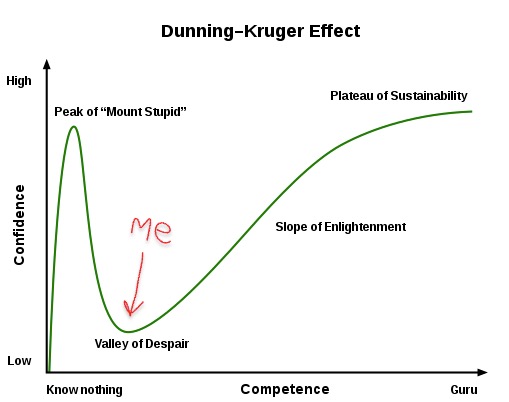
But at some point, with enough time spent on truly understanding the priors, you can get to a Planck level knowledge
Take aways
Especially as you are about to start rad training
- Spend time understanding the basics
- Question
- Keep a medical logbook
experts and mastery
to get good at anything takes at least 10 years+
I’ve been thinking about ‘becoming an expert’. Mostly because I am about to embark on five years of specialisation in radiology.
My future brain is going to look very different. There’s going to be remodelling in the visual circuits. There’s going to be a deeper understanding of concepts in physics and pathophysiology of medical conditions. Procedurally, I might learn how to guide wires through 5mm vessels using X rays, and dislodge clots in someone’s brain (crazy). So much more. I’m pretty excited.
Here are some thoughts around this theme of ‘becoming an expert’
increasing complexity
Science (as a body of knowledge) is becoming too complex for any individual to understand. Newton may have been able to lock himself in a room and understand classical mechanics, but this is no longer the case. The idea of a lone genius is a myth.
All the major technological solutions are as a result of a network of individuals sharing their expertise and knowledge. Science as an endeavour, combined with economic incentives and a health dose of luck, leads to large scale technological change.
For example : Steve Jobs is often thought of a lone genius. That’s not the case at all. He was embedded in a team of engineers, designers, managers, financial advisers etc. It’s hard to predict whether or not we would have the iPhone without him, but he certainly wouldn’t have been able to make it by himself.
Being a polymath / generalist is becoming less common. Less economically rewarded. Even with management, you may not need a pHD, but you do need to understand the space well (which I would argue is expertise).
You want to become a specialist in an area. As Matt Ridley says :
Specialise as a producer, so you can diversify as a consumer
Pick a field that you are
- Interested in
- Good at
- Congruent with values
And then throw yourself into deeply understanding it and work on it for at-least 10 + years to have any chance of a macro impact.
to be in the 0.01% - you need to sacrifice your life
I think to be the best scientist - you would have to work something like an athlete. Dedicate your life purely to understanding.
For example - To truly understand quantum mechanics from the ground up, you’d have to start building up the foundation of knowledge from around 5-6 years old.
Then you would have to study within academia for the next few decades to come to a cutting edge understanding of the field and potentially contribute. Even then, your lone contribution may add nothing. Many radical discoveries in science are luck based.
This involves sacrifice.
is it worth being the ‘best’ in the end?
By the best, I really mean ‘0.0001%’, one in the a billion.
It comes at a cost. You would have to choose to neglect aspects of your social life, relationships, other areas that life has to offer.
For some, yes it is worth it, because that is what they have been trained to do from a young age. Their whole cognition has been built from the ground up to be able to operate at the edge of a field.
But should you worry that ‘you’ are not the best?.
Aim to have a local net positive
My current view is rather than aiming to be the best, you want to have a local net positive.
Start with ‘micro changing the world, rather than ‘macro changing the world’
And the centre of this is ‘you’. Ensure first of all, you inherently enjoy the work you do. Going back to my post of autotelism
Doing work simply for the pure ‘art’ of it. Enjoying the process rather than any particular outcome
The happiest people I know are the ones who make a living doing something that pays well, and they do their art for the love of it— Derek Sivers
From then, you can branch outwards and make changes in your local environment.
solve micro problems first > macro problems
Example of macro : Climate change, AI in Medicine, Poverty, Digitising the NHS, Nuclear disarmament.
Example of micro : Your mental and physical health, your families health, your patients health (medicine is at default a ’non scalable endeavour’ - you are dealing with a patient in front of you’), writing a script to automate certain tasks, building a a small app to store quotes, reaching out to someone you haven’t spoken to in a while. The list goes on.
For your own mental sanity, focus on these small problems that actually impact your life on a day to day basis.
For the macro problems, there is no use worrying about them. I’m not saying they are not worrying, but it is too much weight on a single pair of shoulders. We have not evolved to be in a constant state of worry about events 5000 miles away.
If you sort out the micro, you can move onto macro problems.
I was watching Yuval Noah Harari and someone asked how best to tackle the main challenges of the 21st century (technological disruption, nuclear war, climate change)- and he recommended
For macro problems - Join institutions and organisations.
There is no such thing as an individual who has an outstayed impact on humanity. They all stand on the shoulders of giants, and embedded in a vast ecosystem of knowledge and skill. The idea of a lone genius is a myth
The world is becoming too complex for any single individual to understand. So we must outsource our knowledge to authority in most matters, but pick a field where we can become an expert ourselves and learn from the ground up.
Conclusion
- Get (really) good at something
- Solve micro problems in your life
- Join institutions for the macro problem you want to help solve
I think this is a much more peaceful way to live, compared to the ‘hustle culture’ that you see in some areas. Paradoxically, it may be more effective, as you need a clear mind to solve the truly complex problems.