freedom
TLDR : A compendium of current thoughts on freedom
Political and ideological freedom is up-stream of financial freedom
You want to have ‘f’ u money, and then think about ideologies and politics. Money is the engine of change (a reality) - and fuels innovation (science, spreading of memes, technologies).
You can’t worry about politics when your own house is not in order. Pay your bills first. Locally fix, before thinking about global issues.
Freedom to vs freedom from
These are distinct. Freedom ’to’ is about doing anything you want. Freedom to move. Freedom to buy / create. It involves the external world. Imposing your will on changing the world.
Freedom ‘from’ is about removal. It is usually internally focused. Freedom from ‘desire’, freedom from aversion, freedom from delusions/dogmas etc.
You may not always have freedom to ‘do’ whatever you want. Does satisfying all your desires lead to happiness/contentment anyways? Think about this
Freedom ‘from’ is much more lasting.
Freedom to do whatever can be paralysing
Paradox of choice : an ocean of potential experiences is infront of you. By choosing how you are spending your time, you are inherently cutting off all the other potential futures.
At some stage in your life, you want to start committing to things. This means limiting your freedom. When you have all the options, you are technically free, but you are not invested in anyone/anything.
As you get older, finding a spouse means foregoing your freedom to pick anyone. Creating a family and having kids means letting go of your freedom of time. Choosing a career means letting go of all the other potential options.
Some may want to remain completely free in their late 30’s/40’s/50’s - but from what I see, it can lead to loneliness and a lack of purpose.
Note : It doesn’t have to, I’ve met several people in their 40’s/50’s who externally free (no family/spouse) - but often they have worked on some sense of internal freedom.
Freedom from is more durable
External freedom is needed, but not always possible.
Internal freedom is always possible. You can be externally in a horrible situation, but internally at rest.
Cultivate the ability to be free from negative states.
But of course, have freedom ’to’ do in important domains. Just realise that you are not actually free ’to do’ anything. I am not ‘free’ to join the NBA (I don’t know how to play basketball).
trial and experiment
Before you commit, trial the experience/item
Before you make a major financial purchase e.g. moving location, buying a large/expensive item, see if you can ‘rent’ or ‘trial’ it.
I think I’ve made this mistake a lot. Often buying items that didn’t really improve my quality of life or contentment (or of others around me) but instead became a burden
What you own ends up owning you
Examples
- I bought a cycle with the idea that I would cycle to work. I’ve cycled 3x in total
- I bought a drum kit- which is now adding the pressure of learning the drums, and taking up space
- Gaming computer. Rarely touched since I’ve lost interest at the moment
- Clothes that looked good, but I wouldn’t wear at all.
The solution is to trial things or rent them before making a dive
For example: I have this notion of living in London, and commuting to Luton. The idea is that I am missing out in some way by not being in an epicentre during my 20’s
Therefore this week I’ve trialled the idea. I rented out a small airbnb right next to St Pancras, rented out a Brompton, and trialled a commute.
It’s far less expensive than committing to it 100%, and then releasing that it made your life worse.
Trial as close to how it would be, before making a purchase
This is a subset of the advice to ignore theory. Try. Do things, don’t think. The disease of the thinking mind as Bruce Lee talked about. Obviously thinking is valuable, but often the default tendency is theory over action.
I now have practical takeaways
- I know exactly how long the commute is
- I know how annoying it is to take a bike everywhere
- I know about train delays
- I know how expensive the train ticket is and cost of living
- I know how it feels to have to be in for 8am
- I know how peaceful being on the train is
- I know that being in Central doesn’t automatically result in a network
- I know I would spend all my money on food and eating out
- I know how nice it feels to be within 20 mins of some of the most interesting activities
- I know how loud and annoying it can be
- I know how to live in a box
- I know how to fold a Brompton now
- I know that I enjoy reading, writing, silence on the commute.
- I know that I would leave behind a decent social network (at least for me) if I moved
Overall, the commute was too long (for now!).
Once you trial it- make a decision and make it final. You should have enough data to make an informed choice.
We know for peace of mind- make irreversible decisions.
Conclusion
Rent before you buy. Trial before you buy. Make notes on your experience. Then make an informed choice with real world data.
Note: I’m writing this on the train. One of the benefits of a train commute.
skill trees
TLDR: Generalist vs Specialist
I sometimes like to think of life as an RPG. You have an avatar - a blank slate. You start of at level 1 at most skills, and then the more time and deliberate practice you put into skills, the better you become. You ’level up'.
Obviously the analogy isn’t entirely accurate. Video games are bounded, and life is unbounded. There is no end point. There is no ‘victory’. You often have to set the goal posts yourself. Life is also full of inequality. Not everyone starts off at level 0.
But humour me.
In RPG’s you can choose a ‘class’. You can then assign skill points in various trees. You can choose to to ‘deep’ into a skill tree. Or you can become more of a generalist, and spread those skill points around.
This brings up the question :
Is it better to master one skill or be a jack of all trades?
How do you choose which skills to develop, which trees to go down, where to put your ‘metaphorical points’. It’s a deeper question of : how do you choose to assign your time.
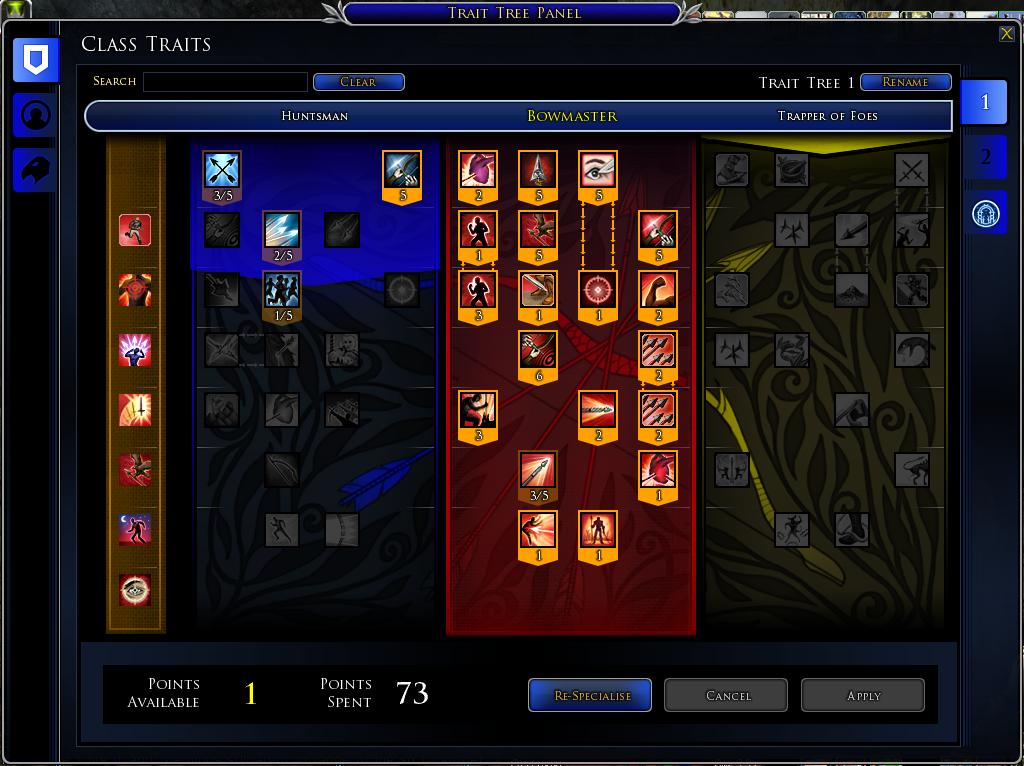
‘Choose your character!’ (My LOTRO Hunter Skill Tree)
the min maxer
‘Min-maxing’ is the concept where you put all your points deep into one skill tree, and neglect others. You therefore become hyper-specialised at a certain skill (DPS/Tank/Healer), but at a cost. For example : the glass cannon - putting all your points into DPS (damage per second), but becoming ultra squishy.
Applying this analogy to life. The min-maxer might be the brilliant genius scientist, who has hyper specialised in physics. They’ve put all their skill points into deeply understanding physics from the ground up, and have become top 0.0001% in the world. They’ve neglected other skillsets to become hyper specialised.
Arguably this is what ‘genius’ - as Alexey Guzey writes. Focusing on a few topics and going way beyond what anyone else would devote to it.
It’s about reaching the cutting edge of humanity’s collective intelligence on a topic, and then going beyond it. Expanding the circle of collective intelligence.
The danger of the min-maxer is that they burn out, or neglect aspects of their life so much that it becomes a hindrance. (Look at all the famous artists who were unbalanced/lived short lives).
the generalist
The generalist chooses to go more superficially into multiple trees. They are not as deep as the min-maxer, but they can be better than ‘average’.
They may choose to have a basket of hobbies and interests, and devote equal time to them. They may even start many hobbies and drop them.
The danger of the generalist is that they spread themselves too thin, and therefore remain subpar at everything they do.
Which is ‘better’?
Depends on what you are optimising. For contentment/happiness/peace, arguably mastery doesn’t factor into it. You don’t need to be good at anything.
This is what the Pixar film ‘Soul’ touches on. Compare that to ‘Whiplash’ - the frantic pursuit of excellence and mastery. But that is a different discussion.
what should you do?
From a birds eye ‘humanity’ aspect : we need both generalists and specialists.
If you want to min-max : I am in awe of you. I never min-maxed in RPG’s. I was the guy who put points into all the trees.
Speaking to future me : I would argue that being a generalist but limiting the number of domains is smart.
Pick a few skills and become good at them. Especially economically - Matt Ridley advocates
Specialising as a producer, so you can diversify as a consumer
Your vocation/career should involve a level of craftsmanship and mastery. That is valuable.
As I said, the video game analogy isn’t perfect because not everyone is born with the same innate abilities. Some things come easier to you than others (this may be due to early childhood exposure/genetics/environment - it’s a vast confluence of factors).
But you should
Pick a ‘class’ : Hunter/Tank/Mage. The analogy would be to pick a skill/set of skills. You can’t be ‘all the classes’. You can’t do everything. True freedom is not feasible. It involves choosing one path over another.
Ideally pick something in which there is an element of mastery (you can go deep), that is intrinsically enjoyable to you, that is practically feasible ( don’t decide you want to master surfing living in rural Scotland).
Deliberate practice : you can put time into it and improve. This doesn’t mean doing the same thing again and again, but training ‘smart’.
I’ve been thinking about this topic because I’ve picked up a few different skills that I’ve wanted to learn for a while. (Drums, Brazilian Ju Jitsu, Climbing).
But I’m now putting less time into other interests (Programming, Writing, Gymnastics, Guitar).
At some level they help each other. Gymnastics helps climbing. Knowing guitar helps learning drums and vice versa. But I am dangerously close to spreading myself too thin. Suddenly having so much free time has meant I wanted to tick off as many ‘bucket list’ items as I could. Probably need to drop something or accept subpar progress in some domains.
Conclusion
A reasonable approach is to treat life as a series of 5 year experiments. So for ‘5 year stretch’, you may focus on career/becoming a better whatever you do for a living. Then another 5 years, you may focus exclusively on becoming proficient at a martial arts. Then another at learning an instrument.
This is a better alternative than to try tackle several skills at once.
This post is just coming to terms that I think I’m going to have to drop learning the drums temporarily, and focus on putting points into the skill trees I’m already invested in.
Areas I should go deep in
- Calisthenics
- Climbing
- Guitar
Going to abandon some of the other projects, and leave some space.