a case for local
TLDR: Local is better than global
I’m at one of those transitional stages in life where I’ve been thinking about how I want my life to look like.
It has largely come down to being embedded deeply in a community. Mormon but without being mormon
Modernity
What typically happens as you get older is that everyone distances themselves. Either due to career or spouse. We live in atomised societies. For most people : they take the car everywhere instead of walking.
We barely know our neighbours. We are stuck in long commutes due to necessity. Family don’t live nearby, meaning that couples are raising their child alone without grandparents, aunts or uncles. Our friends don’t live nearby. The social fabric is coming apart at the seams.
This is largely out of people’s control for a few different reasons: loss of large families, travelling for work, rise of secularism, financial necessity. Probably many others
This is more common in the individualistic Western world, but is becoming more common in Eastern societies too.
Hyperlocalism
I think back to when my Mother was a child. She was surrounded by such a large family and community. Every time we would visit India, she would know everyone and I would be frustrated that we had to meet so many people. She was deeply embedded in a community, growing up in the same location, large family, large set of friends. I could tell she acutely felt that loss when she moved to the UK. Living like this is becoming rare in the West.
As a teenager, I had this utopian vision that all my close contacts would be living on the same street, I would walk to work, I would frequent the same cafe, gym etc. I would have the same barber for many years. A ‘hyper local’ environment.
Why is this better?
Why have this mentality? This goes back to my previous post on Friendship and Relationships. I’ve been thinking about this topic a lot.
All the real gains in life are from compound interest. By spending more time with the same people, you develop deeper relationships. Buying your own house is better than renting and moving often. Running into the same people is better than being surrounded by strangers. Walking is better than driving. Working with the same people in your job, is better than working with people who rotate around every 4 months. Having purposeful work is better than meaningless work.
How to achieve this
In my mid 20’s : I think working towards this is possible. A few thoughts :
- Live in such a location where you can walk- Avoid ‘urban sprawl’. Ideas coming to mind : Cambridge, Hitchin, Certain areas of London
- Live near family
- Live near friends
- Live in a place long term
- Live near work
- Live in green environments
- Have a common ‘third space’ that isn’t work or home e.g. gym, yoga, coffee store- where you are a ‘regular’
- Have a large family
This isn’t possible for many due to finances, work, career, and spouse/partner. But I think it is possible for current you.
Conclusion:
I want to grow old doing meaningful work, surrounded by long term relationships, and contributing to a community. Embed yourself in a community
dating
TLDR : 1# Do they make you a better person?
Extension of the post about friendship and relationships.
Who you ’end up’ with as a partner is probably one of the most important decisions of your life.
Dating Framework
Most of life is finding the areas that ‘fit’ you the most without forcing it. Finding the career that seems easy to you and enjoyable. The relationships where core values align, that mostly feel effortless. See ‘homophily and the seven pillars’.
Definitions
- Chemistry : The feeling you get
- Compatibility : how many values align. Long term potential.
- Go on lots of first dates.
- As a rule : always go on a second date. Hard to tell after one date.
- Ideal : Chemistry + Compatibility
- Be honest about yourself. Humans are weird, including you. Thats ok.
How do you meet people?
Three main ways
- Active social life
- Friend of a friend (introductions)
- Dating apps 💀
Dating apps vs IRL
The culture has changed so much since the introduction of dating apps.
Looking at some of the statistics is very depressing. A lot of your swipes don’t end up in matches for a guy. One of many examples. Time- effort ratio skewed
Much better to focus on building a good social network and meeting through weak ties / activities
Go to activities that you already enjoy.
Relationship Rules
These are trite, but useful to keep in mind.
- Don’t go into a relationship expecting the other person to change
- A relationship doesn’t ‘complete’ you.
- Controversial : Don’t keep dating a person unless you see yourself getting potentially married to them. i.e. Don’t lead people on. Be honest about intentions
- Most of the time, ‘mixed signals’ mean NO. See Derek Sivers : Hell Y/N
- You need honest communication on a base of compatibility and mutual respect
Questions to ask yourself
- Do you like who you are around them?
- Do they make you a better person?
- Are you having fun?
- Do you have good conversations?
Ignore this section
I don’t think having a ‘checklist’ that you judge people with is useful. But having some of the below in common helps. The first one is probably the most important, and the rest kind of stem from that.
Qualities
- Self awareness and ability to change (Growth mindset)
- Emotional stability (low neurotic)
- Kindness
- Loyalty
- Similar long term goals
- Shared sense of humour
- Family compatibility
- At least a few shared interests
We sometimes hear that opposites attract, and maybe they do for a hookup. More often, similarity is the essence of compatibility. Studies have repeatedly found that couples who are similar in areas such as socioeconomic status, education, age, ethnicity, religion, attractiveness, attitudes, values, and intelligence are more likely to be satisfied with their relationships and are less likely to seek divorce. (Defining your 20’s)
One match maker to consider is personality. Some research tells us that, especially in young couples, the more similar two people’s personalities are, the more likely they are to be satisfied with their relationship.
The WaitButWhy article below is 10/10.
Resources
friendship is important
‘The human social world is possibly the most complex phenomenon in the observed universe’
I want to articulate all my thoughts on Friendship concisely.
I had previously examined the importance of relationships, but growing a year older, combined with the coronavirus pandemic has highlighted the importance of relationships.
I will be referencing a book I’ve read recently by the anthropologist Robin Dunbar. The book goes into a lot more detail and explores other topics, but I’ll enumerate some of the points that resonated with me.
Loneliness Epidemic
Loneliness is becoming more of an epidemic. Especially for older populations. It’s associated with increased all cause mortality The book cites several studies showing increased risk of Alzheimers, mental health problems, and surprisingly many physical biomarkers such as blood pressure, CRP, BMI were worse with individuals with poor networks.
Evolutionary basis : if you were a ’lone wolf’ you would die off. We are intensely social creatures
Friendship provides a sense of belonging - a ’need’ expressed by Maslow
TLDR : Having a poor social network is very bad for your physical and mental health
How many friends should we have
The size of social networks is surprisingly uniform across societies
Dunbar’s number : we can maintain around 150 relationships in total- but in persistent clusters
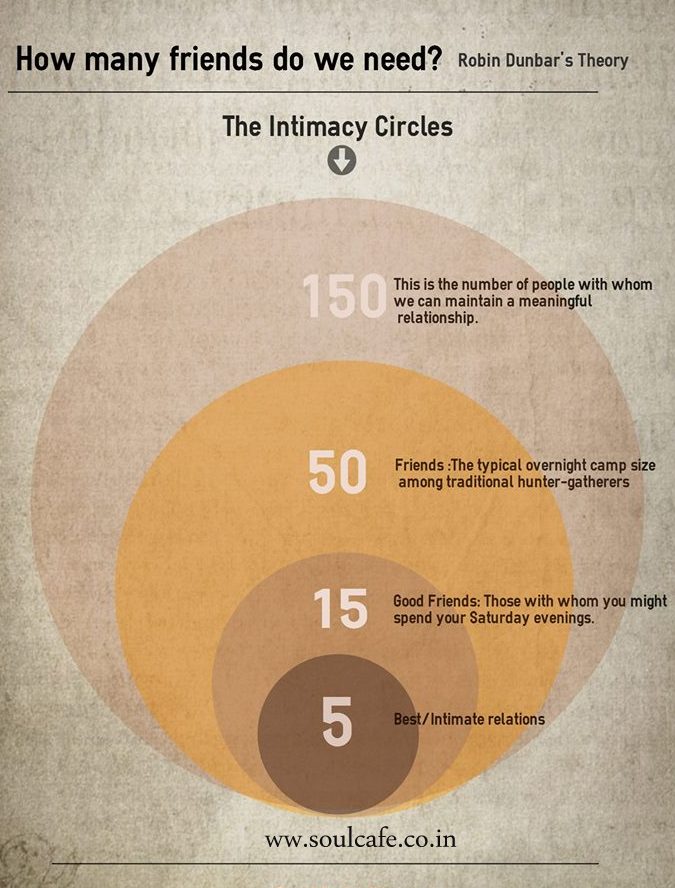
Centre : You
‘5’ intimate friends : contact at least once a week and feel very emotionally close to We devote about 40% of our total social time to these 5 people We get our ‘intimacy’ needs from these 5 people
‘15’ sympathy group : good friends We devote about 20% of the time to next 10 people 15 layer is where you draw most of your every day social companions from. We get our ‘socialising’ needs from these people.
‘50 layer’ : your party friends- ones you would invite to a BBQ or birthday or anniversary party
Beyond this is acquaintances
All these layers include family - which is a special type of friend. Blood runs thicker than water and we tend to be more forgiving with family, and ties decay much more slowly.
Difference Between Introverts and Extroverts
- Introverts typically have a smaller network : but spend more time with the people closer in the network
- Extroverts have larger networks, but spread it more thinly across more people
How to make friends as an adult
Sociologists identify 3 prerequisites to make friends
- Proximity
- Repeated unplanned interactions
- Setting that encourages vulnerability/ Shared activity
Amount of time you invest in a relationship is the main predictor of whether it will thrive.
Distance matters a lot : friendships wither away without in person meet up. Family is less susceptible to this ‘Thirty minute rule’ : you will make an effort to see someone and view them as important to you if they live within thirty minutes travel time of where you live.
Work as a source of friends : as an adult you are limited to a few different options :
- Making friends at work
- Reaching out to old friends
- Joining regular groups
Homophily and 7 pillars of friendship
The adage : ‘birds of a feather flock together’ is true both in friendship and romantic relationships. We find it much easier to be friends with like minded people (termed homophily)
Sociologists identify 7 key pillars
- Having the same language/dialect
- Growing up in the same location
- Having had the same educational and career experiences (e.g. doctors gravitate together)
- Having the same hobbies and interests
- Having the same world view (combination of moral views, religious views, political views)
- having the same sense of humour
- having the same musical tastes (surprising)
The more pillars you have in common, the closer in your ’network of friends’ they are likely to be.
‘Friendships are born, not necessarily made’ - you just have to find the right people with whom friendship is frictionless.
We tend to prefer people of same age, sex, ethnicity
You become the people you surround yourself with. ‘You’re the average of the 5 people you spend the most time with’
Activities such as : Singing, eating together, cultural traditions, dancing, laughing, sharing stories are important cohesive factors
Difference between Men and Women
- Men connect shoulder to shoulder
- Women connect face to face
- Conversation frequency had no effect on how likely a relationship was to survive for boys. Instead it was making the effort to do activities together
- Meeting regularly in ’third spaces’ - classes/gym/climbing/yoga/etc: and performing activities is the main way that men formfriendships
Friendships as you age
- Network size increased till about age 30 - then stabilised- and began to decline from the age of 60 (death, moving away)
- Loneliness is a bigger problem for men - who tend to have smaller social networks which are less emotionally driven
- Physical mobility, lack of integration within society, not understanding references all make it difficult for older populations to relate with younger
- [Prediction : VR and AR will make it much easier for older people to interact digitally allowing physical limitations to be ignored’. Technology rocks ]
- Older adults with poorer social networks were at significant risk of cognitive decline - being well integrated into a society is critical for health ageing
Social Media
Interestingly, most of our interactions on social media are with people we see in real life regularly. ‘People declare that they have around 15 real friends no matter how many Facebook friends they had’
Social media is useful to maintain weak ties i.e. the ‘50 party friends’ beyond
Useful to have a larger network of weak ties in your younger years - so that when you inevitably move you can reach out and rekindle friendships
Interactions that occurred face-face (even via Skype) - much more satisfying than voice call/text. Frequent face-face contact matters a lot (especially for men who connect via activity)
‘Facebook and other digital media might be very good for keeping a friendship ticking over when you can’t meet up so easily, but my feeling is that all it does is slow down the rate at which friendships naturally decay with time when they are not continually reinforced’…. ‘What is essential if you want to keep the friendship going is to meet up from time to time to renew the spark
‘Active social media use seemed to reduce symptoms of anxiety and depression, passive use has the opposite effect’. i.e Create rather than consume
Random Points
Conversation groups are always max of 4 people. Once it reaches 5, you consistently see it split into a group of 3 and a group of 2
Topics I didn’t talk about that the book addresses
Didn’t enumerate these as they aren’t relevant at the moment
- Death and divorce
- Why relationships fall apart (TLDR: Trust)
- Further differences between women and men friendships
- Romantic relationships
- Science behind connection (neurochemistry) and importance of touch
Actionable points :
- Join regular groups - especially as a man
- Make an effort to reach out to people and meet regularly - friendships slowly die without regular in person/video contact
- 20’s is exploration phase : finding the right people with whom you can be friends with- and investing in them