planck vs chaffeur
Extension of my previous post on how doing anything great takes at least 10 years
Examining the difference between ‘deep knowledge’ and ‘superficial knowledge. Other ways of articulating:
- memorising vs understanding
- Recall vs relationship
- real vs pretend knowledge
Planck vs Chauffeur Knowledge
Charlie Munger recounted in his 2007 Commencement to the USC Law School:
“I frequently tell the apocryphal story about how Max Planck, after he won the Nobel Prize, went around Germany giving the same standard lecture on the new quantum mechanics.
Over time, his chauffeur memorised the lecture and said, “Would you mind, Professor Planck, because it’s so boring to stay in our routine. [What if] I gave the lecture in Munich and you just sat in front wearing my chauffeur’s hat?” Planck said, “Why not?” And the chauffeur got up and gave this long lecture on quantum mechanics. After which a physics professor stood up and asked a perfectly ghastly question. The speaker said, “Well I’m surprised that in an advanced city like Munich I get such an elementary question. I’m going to ask my chauffeur to reply.”
The story articulates the difference between superficial understanding and deep understanding. Max Planck understood the topic, whereas the chauffeur was simply able to repeat.
What is the difference?
understanding is relational
Understanding is based on building on prior concepts, and seeing how they relate to each other
understanding takes time
Going back to the previous post. To develop deep understanding within a field takes time.
you can apply the concept to other contexts
For example : in computer science, understanding abstraction as a concept can be applied to other fields. Or in chemistry, the concept of activation energy.
You can explain without jargon
knowing the name of something doesn’t mean you understand it
The ultimate test is the ability to explain it to a 5 year old. I love this video where a neuroscientist explains the idea of a connectome
How do you develop Planck knowledge ?
Chauffeur knowledge is not bad
Having a superficial understanding of a topic is not a bad thing
What is bad, is pretending to have a deep understanding and deceiving yourself and others
You are going to start off by having superficial knowledge. What is important is :
- Deeply learn the basics
- Build on top of these concepts
- Question
- Think Deeply About Simple Things
- Keep a beginners mind
- Don’t obfuscate with jargon
Imposter syndrome is part of the process
You’re going to start off as the chauffeur.
In fact in the start you’ll think you understand something deeply (Dunning Kruger)
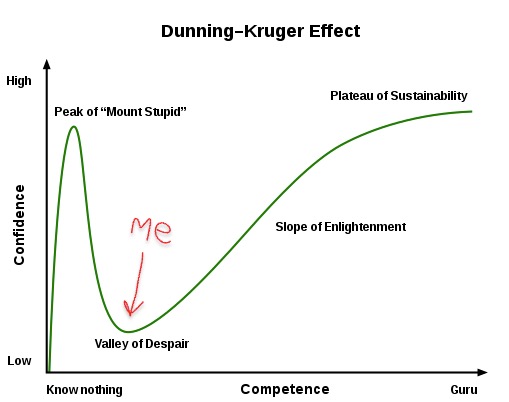
But at some point, with enough time spent on truly understanding the priors, you can get to a Planck level knowledge
Take aways
Especially as you are about to start rad training
- Spend time understanding the basics
- Question
- Keep a medical logbook
experts and mastery
to get good at anything takes at least 10 years+
I’ve been thinking about ‘becoming an expert’. Mostly because I am about to embark on five years of specialisation in radiology.
My future brain is going to look very different. There’s going to be remodelling in the visual circuits. There’s going to be a deeper understanding of concepts in physics and pathophysiology of medical conditions. Procedurally, I might learn how to guide wires through 5mm vessels using X rays, and dislodge clots in someone’s brain (crazy). So much more. I’m pretty excited.
Here are some thoughts around this theme of ‘becoming an expert’
increasing complexity
Science (as a body of knowledge) is becoming too complex for any individual to understand. Newton may have been able to lock himself in a room and understand classical mechanics, but this is no longer the case. The idea of a lone genius is a myth.
All the major technological solutions are as a result of a network of individuals sharing their expertise and knowledge. Science as an endeavour, combined with economic incentives and a health dose of luck, leads to large scale technological change.
For example : Steve Jobs is often thought of a lone genius. That’s not the case at all. He was embedded in a team of engineers, designers, managers, financial advisers etc. It’s hard to predict whether or not we would have the iPhone without him, but he certainly wouldn’t have been able to make it by himself.
Being a polymath / generalist is becoming less common. Less economically rewarded. Even with management, you may not need a pHD, but you do need to understand the space well (which I would argue is expertise).
You want to become a specialist in an area. As Matt Ridley says :
Specialise as a producer, so you can diversify as a consumer
Pick a field that you are
- Interested in
- Good at
- Congruent with values
And then throw yourself into deeply understanding it and work on it for at-least 10 + years to have any chance of a macro impact.
to be in the 0.01% - you need to sacrifice your life
I think to be the best scientist - you would have to work something like an athlete. Dedicate your life purely to understanding.
For example - To truly understand quantum mechanics from the ground up, you’d have to start building up the foundation of knowledge from around 5-6 years old.
Then you would have to study within academia for the next few decades to come to a cutting edge understanding of the field and potentially contribute. Even then, your lone contribution may add nothing. Many radical discoveries in science are luck based.
This involves sacrifice.
is it worth being the ‘best’ in the end?
By the best, I really mean ‘0.0001%’, one in the a billion.
It comes at a cost. You would have to choose to neglect aspects of your social life, relationships, other areas that life has to offer.
For some, yes it is worth it, because that is what they have been trained to do from a young age. Their whole cognition has been built from the ground up to be able to operate at the edge of a field.
But should you worry that ‘you’ are not the best?.
Aim to have a local net positive
My current view is rather than aiming to be the best, you want to have a local net positive.
Start with ‘micro changing the world, rather than ‘macro changing the world’
And the centre of this is ‘you’. Ensure first of all, you inherently enjoy the work you do. Going back to my post of autotelism
Doing work simply for the pure ‘art’ of it. Enjoying the process rather than any particular outcome
The happiest people I know are the ones who make a living doing something that pays well, and they do their art for the love of it— Derek Sivers
From then, you can branch outwards and make changes in your local environment.
solve micro problems first > macro problems
Example of macro : Climate change, AI in Medicine, Poverty, Digitising the NHS, Nuclear disarmament.
Example of micro : Your mental and physical health, your families health, your patients health (medicine is at default a ’non scalable endeavour’ - you are dealing with a patient in front of you’), writing a script to automate certain tasks, building a a small app to store quotes, reaching out to someone you haven’t spoken to in a while. The list goes on.
For your own mental sanity, focus on these small problems that actually impact your life on a day to day basis.
For the macro problems, there is no use worrying about them. I’m not saying they are not worrying, but it is too much weight on a single pair of shoulders. We have not evolved to be in a constant state of worry about events 5000 miles away.
If you sort out the micro, you can move onto macro problems.
I was watching Yuval Noah Harari and someone asked how best to tackle the main challenges of the 21st century (technological disruption, nuclear war, climate change)- and he recommended
For macro problems - Join institutions and organisations.
There is no such thing as an individual who has an outstayed impact on humanity. They all stand on the shoulders of giants, and embedded in a vast ecosystem of knowledge and skill. The idea of a lone genius is a myth
The world is becoming too complex for any single individual to understand. So we must outsource our knowledge to authority in most matters, but pick a field where we can become an expert ourselves and learn from the ground up.
Conclusion
- Get (really) good at something
- Solve micro problems in your life
- Join institutions for the macro problem you want to help solve
I think this is a much more peaceful way to live, compared to the ‘hustle culture’ that you see in some areas. Paradoxically, it may be more effective, as you need a clear mind to solve the truly complex problems.
midnight library
How do we make meaningful choices?
This book is about infinite possible futures.
It’s similar to Borges ‘Library of Babel’, but has the protagonist (Nora) explore all the infinite versions of the life she could have lived. She starts from a place of despair- a suicide attempt- and finds herself in a space in-between life and death called the ‘Midnight Library’
From there, she has the option to pick any ‘life’ she could think of. What if she had made different choices? What if she had asked out that person, or accepted a job offer, or moved location, or any number of infinite choices?
And from all these infinite choices, which is the ‘right’ choice exactly? What is the ‘best life’.
The Midnight Library is an exploration of contentment, regret, loss and love.
This is a timely book because I’ve been thinking about all the possible futures that could have been. What would have happened if I had chosen my medical training elsewhere, what would have happened if I hadn’t chosen to break off a relationship, what would have happened if I hadn’t had a bereavement. What if I had chosen to take a year off. What if I had said yes to a meaningless audit and scored an extra point on my application that led to being in a different location. What if I had said yes or no to countless opportunities. The list goes on ad infinitum.
How do we know that the choices we make are the ‘right’ choices? In an alternate universe where you chose the opposite, would life be ‘better’? Would it be worse? How do we make meaningful choices?
Two roads diverged in a wood… What if there are more than two roads… what of if there is no end to the choices you could make. What would Robert Frost do?
The Choice is not the issue
Worrying about cause and effect in the grand scheme is a recipe for suffering. You can choose choices, but not outcomes.
Whatever choice you make. It’s gone.
Regret is a thought. All the possible futures are simply thoughts arising in the mind that we confuse for reality. It is impossible to quantify whether the series of choices that you made differently could have ‘ended’ in a better outcomes, because ultimately each path she took had its own meaning, purpose and sense of both pleasure and pain.
Pain and pleasure exist. Regardless of whether Nora became a world famous Swimmer or a suicidal drug addict. People died. Friendships ended. Conversely, each life had its own joys. Each ‘life’ came with ‘good’ and bad’.
In one version, after exploring fame, wealth, intellectual pursuits etc, she becomes a mother, living in Cambridge, happily married, everything seemingly content. She can choose to stay in that life if she ’truly wants it’. Yet even that slips beyond her and she returns to the Midnight library, because it is not real.
In the end, all possible futures don’t exist, because they are fictions. When one holds onto them too tightly, they cause suffering, because they implicitly say ‘that this life is not good enough’.
In reality, this moment is perfect. The universe is perfect. It’s only in the mind that imperfection arises.
The prison wasn’t the place, but the perspective.
Change the way you see
And so Nora returns to her life. The ‘root’ life where she took the overdose. Where all the choices she made, were made as they were. But she comes back seeing differently. Because life ‘just is’. It is the way we see it that imbues it with meaning.
She realises that the choices she made are neither ‘good nor bad’, but as Shakespeare said ‘only thinking makes it so’. It’s the way you look at life. She saw that in this timeline, her brother was still alive, she was giving piano lessons to a kid (who in another timeline got involved in a bad crowd and went to prison), and that her best friend in New Zealand didn’t die in a car crash. There was both pleasure and pain in this life, but she could ultimately choose what to look at.
The issue was she was searching for meaning outside of herself. In a universe devoid of ultimate meaning, it is YOU, who chooses what is meaningful.
The arrow of time, entropy marches continually forward. The choices we make are neither good nor bad. When comparing choices you should look inwards, and create reasons generated internally.
Every path is the right path.
The future will arrive. A never-ending series of infinite crossroads diverging into infinite roads, ending in the same destination. The beauty is realising : every choice is the right choice. Life is a playground.
I’ll end with this passage in the book
“ It is easy to mourn the lives we aren’t living. Easy to wish we’d developed other talents, said yes to different offers. Easy to wish we’d worked harder, loved better, handled our finances more astutely, been more popular, stayed in the band, gone to Australia, said yes to the coffee or done more bloody yoga. It takes no effort to miss the friends we didn’t make and the work we didn’t do and the people we didn’t marry and the children we didn’t have. It is not difficult to see yourself through the lens of other people, and to wish you were all the different kaleidoscopic versions of you they wanted you to be. It is easy to regret, and keep regretting, ad infinitum, until our time runs out. But it is not the lives we regret not living that are the real problem. It is the regret itself. It’s the regret that makes us shrivel and wither and feel like our own and other people’s worst enemy. We can’t tell if any of those other versions would have been better or worse. Those lives are happening, it is true, but you are happening as well, and that is the happening we have to focus on. Of course, we can’t visit every place or meet every person or do every job, yet most of what we’d feel in any life is still available. We don’t have to play every game to know what winning feels like. We don’t have to hear every piece of music in the world to understand music. We don’t have to have tried every variety of grape from every vineyard to know the pleasure of wine. Love and laughter and fear and pain are universal currencies. We just have to close our eyes and savour the taste of the drink in front of us and listen to the song as it plays. We are as completely and utterly alive as we are in any other life and have access to the same emotional spectrum. We only need to be one person. We only need to feel one existence. We don’t have to do everything in order to be everything, because we are already infinite. While we are alive we always contain a future of multifarious possibility. So let’s be kind to the people in our own existence.”
Mr Nobody is another one of my favourite films that explores this topic. Here is an essay by ‘Like Stories of Old’ :