experimenting with veganism
Summary : Eat real food, mostly plants, not too much.
Over this past year, I’ve experimented with a vegan diet.
I actually started out knowing little about the ethical aspect of it. In fact I hopped on the bus for the purported health benefits. It was a useful experiment. I stuck to eating mainly vegetables, grains and beans for next 6 months (essentially a Mahastastran diet without dairy) and learnt how to cook decent vegetarian food.
But after a year, I’ve reassessed and am back to eating an omnivorous diet. Few reasons why.
Too easy to lose muscle mass/weight.
Certain micronutrients are missed out on a vegan diet. Especially omega’s in fish, but many more
Nutrition exhibits genetic variation. How you respond to certain macronutrient splits is dependent on your genetic profile e.g. insulin sensitivity, tendency to put on weight (FTO gene +ve in my case). I respond poorly to high carbohydrate diets which veganism tends to fall under.
Subjectively felt a lot better going back to eating fish
People get very dogmatic about veganism. That has also put me off. Especially in citing nutrition research.
The evidence behind some of the nutrition claims of the 21st century are hugely flawed. They are observational studies (very poor quality). The whole state of nutrition science is in fact terrible.
However one aspect, I cannot argue against is the ethical argument of veganism/vegetarianism.
Ethical Case for Veganism
It’s think that half a century into the future, mankind will look back with reproach at how animals were treated for consumption; factory farming en masse.
Fortunately, it’s likely in the future we will transition to GMO and organically grown meat rather than factory farmed methods. The fact is : that massive suffering and oppression of sentient beings is occurring globally.
Now diet is a sensitive issue for most. People often take a dogmatic approach siding with certain ‘camps’. “I’m vegan, all meat eaters are terrible people” or “vegans are just malnourished hipsters ” or “humans were meant to eat meat, you need the protein” etc. This sort of binary thinking is the wrong approach. “Only a Sith deals in absolutes” as Yoda would say.
I don’t think that the only way to be ‘ethical’ is to become a vegetarian or vegan.
It’s way too hard for the majority of the population. On a macro scale it probably won’t have the intended consequences Hypothetically if we cut meat consumption in half and sourced it from ethical methods, that is 10x better than even doubling or tripling the number of current vegetarians. Reduction rather than replacement. We can’t expect the 1.5 billion people in China entering the middle class to become vegans. They will eat meat.
Would you rather have 10,000 people opt for 50% of their current meat consumption and eat more vegetables- or 100 people switch to vegetarianism. The latter just doesn’t have enough of an impact.
Even if you do become vegetarian, you simply switch to eating eggs and it’s arguable that egg laying chickens are the worst treated of all animals. In terms of animal suffering, the solution isn’t always so clear. It’s true we can never have perfect knowledge about the consequences of our decisions.
Factory farming though should be phased out.
How do we change? Most people are following a processed meat, dairy, egg heavy diet rather than a strict paleo or a vegan diet. It’s not feasible that they will go from 0 – 100 and end up sticking with it. What instead needs to happen is that the needle needs to moved slowly in the right direction with our consumer purchases. ‘Vote with your wallet’. Buy ethically sourced goods.
‘But what effect can I have? You would be surprised by the first order effects of your consumer decisions. Companies are incentivised to provide for the consumer. ‘The consumer is always right’. It’s why you have more Walmart and fast food restaurants in economically deprived areas of the US instead of Whole foods. If instead those people went out and drove 20 minutes to buy ethically sourced products, companies will build stores closer to them.
‘Its too expensive’. If you’re in a 1st world country, buying vegetables isn’t too much more expensive. But I understand that for some, they won’t exactly be able to buy Waitrose organic salmon.
Health Benefits On the individual level, switching to mostly plant based foods is the rational thing to do for your health. The general public is inundated with media stories about fad diets, ‘eggs are good’ ‘eggs are bad’ ‘veganism is good’ ‘drink more red wine’. This is all often backed up with pseudoscience and poorly conducted studies. Even with well conducted studies. Do I need a double blind RCT with a placebo group that getting an oversized Russian olympic weightlifter to roundhouse kick me in the groin is going to cause damage. No.
Information overload is a problem especially in this day and age We know what is good : non factory farmed, ethically sourced products and plant based nutrition. Both morally and biologically. Diet is really the topic where the gap between ‘information’ and ‘action’ becomes so visible. We know but we don’t act. Instead the solution is to simplify. Replace ‘diet’ which implies weight loss for many with just ‘food’. Advise patients to eat food that they enjoy and is actually food.
I love Michael Pollans’ (author of the Omnivore’s dilemma) advice on this :
Eat food. Not too much. Mostly plants
Don’t eat anything your great grandmother wouldn’t recognise as food
Don’t eat anything incapable of rotting. Rather than adopting a certain diet, what we need to aim for is making the correct moral decision. Buy the responsibly sourced meat or eggs, eat mainly vegetables, eat meat only sometimes. Learn to cook with fresh ingredients rather than buying packaged goods. The change happens at the individual level with your wallet. As Agent K said in Men in Black ’A person is smart, people are dumb’.
What we eat will always be an issue close to my heart. In this age of overmedication (insert cholesterol lowering drug here) instead of addressing the root cause, doctors simply end up adding more fuel to the fire. As Hippocrates said ‘Let food be thy medicine’. Ultimately eating well has not only physical benefits, but also considerable moral, ethical and ecological (didn’t even cover) impacts. It all starts with the food on your plate.
Rereading in 2019
Sassy.
But pretty much agree with Michael Pollan : eat plants, eat reasonable amount of fish/meat, nuts/seeds. Paleo-like diet.
Wow. I quoted Agent K from Men in Black?! Nice past me. Also what is the analogy about a Russian Olympic weightlifter kicking you in the groin?!*
exams and understanding
Summary : thoughts on exams
If you want to build a ship, don’t drum up the men to gather wood, divide the work, and give orders. Instead, teach them to yearn for the vast and endless sea” Antoine de Saint-Exupéry
Approaching half way through third year of medical school, I’ve had a decent exposure to examinations to say the least. Medical school is a strange place in that you see people on a wide spectrum- those who are absolutely dependent on external validation from exams, and those that say that exams are completely worthless. Both are a cause for concern, and believing in extremes is never a good starting point.
In one way both tend to sacrifice understanding. The overly obsessed, anxious student aiming only for a good ranking can sacrifice understanding preferring to ‘rote learn’ topics. In fact this was the approach my parents had to undertake in the Indian medical school system in the late 1900’s – and they both unequivocally agree that the approach is flawed.
On the other end of the spectrum, the student can become so dejected by the notion of exams that they fail to put in any effort. So what is the solution?
can you explain it to a 5 year old?
I recently came across the ‘Feynman technique’ for learning. The premise is that
- You choose a concept/topic you want to understand
- Proceed to explain the idea to yourself as you write- as if explaining to a new student / layman/ toddler / 5 year old- or whoever you want.
- The crucial part is that you vocalise the process and use easy to understand terminology.
if you can explain it simply then you understand it deeply
Now is it perfect? Depends on your yardstick of measurement. If your measure is exams, then no, it isn’t perfect. You will miss marks on those inane questions that demand you to memorise pointless facts. But will you gain an understanding of a topic for years and years to come that? Yes
Learning in medical school does of course involve memorising certain facts – for example drugs. But even then, I think that due to technology and storage of information, this shouldn’t be the highest priority.
In fact modern day hospitals are run mainly bureaucratically though guidelines on exactly ‘what’ drug to prescribe and how much, so the whether or not the doctor knows a certain drug doesn’t matter- what does matter is that he understands the reasoning behind it. Things have changed a lot since my parents were in medical school.
learn out of curiosity
Merely to acquire information or knowledge is not to learn. Learning implies the love of understanding and the love of doing a thing for itself. Learning is possible only when there is no coercion of any kind” Jiddu Krishnamurti
Ultimately exams are a necessary evil- but should you put your mental wellbeing on the line to achieve the highest grade possible? I guess that is a personal question that I can’t answer for individuals but atleast I can shed some light on my own experience.
What is more important I feel is not to become dejected by the learning process through examinations. I’ve had periods where I (feeling both internally and externally inadequate) worked intensely hard for exams with idea of‘do or die’ and I’ve had periods where I was so demoralised by the process that I stopped.
It is crucial to remember that learning is life long, knowledge is not an end, but a process. Always ask questions. Always be open to learning. In our 20’s, ego tends to flair up for many where with growing knowledge and pressure of performing and success we pretend we understand more than we do (‘scientia infla: knowledge puffs up).
Instead as Bruce Lee advocates- ’empty your mind’. Be receptive and admit when you don’t understand topics.
To conclude, take it step by step: iteration is crucial in any form of long term endeavour. Only by understanding simple concepts can you build on those to grasp more complex ones. Enjoy the process and don’t become fixated on outcomes, (especially those as trivial as examinations).
The Art of Gathering
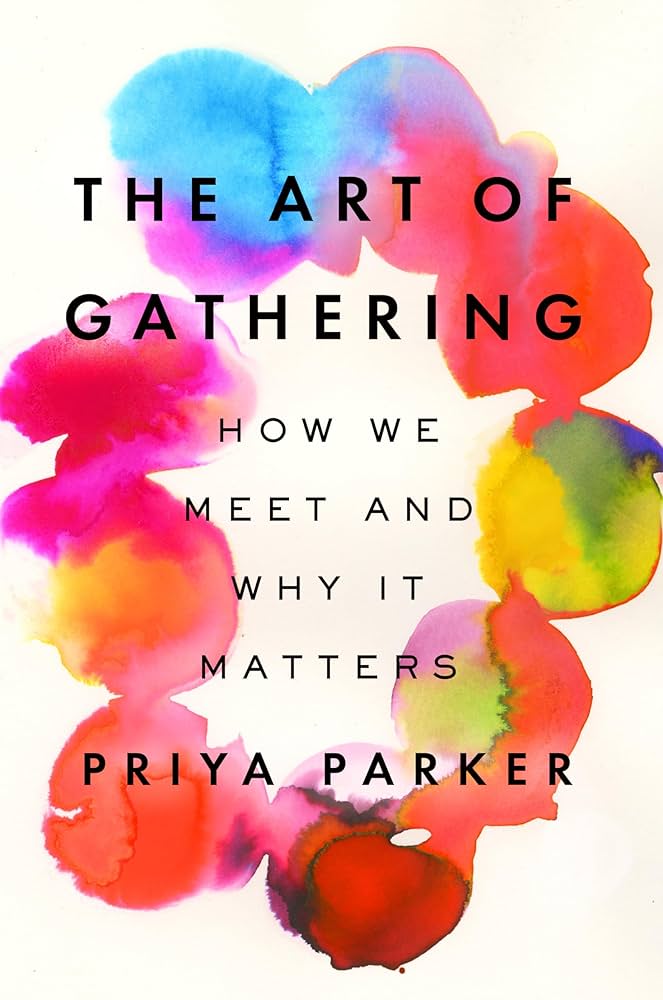
‘How we meet’ is a vital human experience, but too often we don’t give it enough thought.
We spend our lives gathering, with family, friends, in school, at weddings, business meetings, class reunions, dinner parties, sports groups, religious ceremonies, and at the end of our lives, our loved ones gather at our funerals.
We all intuitively know that gathering is important. We can look back and remember times that ‘we gathered well’ and times that weren’t so well. The awkward dinner party where one too many guests were invited, or the social where you weren’t very social.
More and more, we are unhappy with the way we meet. Going to conferences, work meetings or drinks parties, we find that the host has rarely given thought to how guests will connect, why they are meeting, and what they will take away.
There are ways that you can ‘gather well’.
1. Know why you are gathering
You should be explicit to yourself in why exactly you are gathering. ‘Think less about the what, and more about the why’. For example:
Take a birthday. If your ‘why’ is to surround yourself with your loved ones, then invite a small group and have an intimate dinner. If your ‘why’ is to reconnect with old friends and colleagues- then invite a larger group for a barbecue.
Knowing why you are gathering, is the starting point for the rest of your decision making
2. Good gathering requires exclusion
Once you know the underlying purpose of the gathering, you can choose who to invite. And more importantly, who to exclude.
Include only people relevant to the gathering. If you intend to spend time with your school friends, and the intention is to ‘catch up’ - don’t invite a work colleague. (Unless the intention is to meet new people).
The ‘more the merrier’ is not true. How many people depends on the ‘reason why you are gathering’.
3. Don’t be a ‘chill host’
An engaging and generously authoritative host will always deliver than a laid back host
Hosting is a skill. It requires attention and effort. An abdication of power as a host often fails guests rather than serving them.
You have ‘power’ as a host. The author talks about a time she was at a housewarming party, and there was a lull after dinner. The author suggested that they play a game of ‘werewolf’ but the host wasn’t sure that ‘everyone’ would enjoy it. They were unwilling to exercise their power. As a result, the moment passed and the party broke up in an unsatisfying way.
Another example was where the author facilitated a conference with the purpose being to bring together people involved in the agricultural industry. There were 120 people who didn’t know each other. So she utilised her power as a host, and asked that every attendee get up and move to a different table after each speech. Initially it seemed like an imposition, but ultimately at the end of the day, everyone was grateful. This simple rule facilitated the reason ‘why’ they were implicitly gathering - to form new connections. By being at the same table the whole time, they wouldn’t fulfil that purpose.
4. Having rules can be freeing
An addendum to the above. Depending on the gathering, you can set rules as a host. Exercise that power.
Rules can allow for playfulness and meaningful gatherings. Examples include : no phones, arbitrary mixing rules at a social.
5. Introductions and Starts
Prime people before the event of what to expect. Give them a little synopsis. If hosting a dinner, let people know who is coming, what you will be serving, any activities planned, and roughly when it will start and finish.
Then when they arrive, acknowledge this explicitly. Make introductions if needed. Serve them food/drinks. Show them around if a dinner.
6. Encourage authenticity
We all crave authentic interaction. I’ve been in situations where the conversation barely left the superficial, and then led to the group just sitting next to each other on their phones. Most gatherings in university were disappointing in my experience.
How can you encourage authenticity? This is another intention you must hold as a host, and there is no one way. You cannot demand authenticity, but you can create an environment which fosters it.
You can make guests feel comfortable. You can be vulnerable yourself. You can ask for stories about other people’s lives. How to tell stories is a skill itself.
7. Endings
Have an explicit ending. The peak end heuristic states that we remember the peak and the end of any experiences the most.
Therefore ‘how things end’ matters a lot. Make it explicit- if for example hosting a dinner party, you can let guests know that they can leave if they want to, but if they choose to stay they can retreat to the living room etc.
8. Create rituals
Ritualised and regular meet ups are powerful. Try to commit or create a group around a shared purpose. Then aim to meet regularly. This is how you form deeper bonds.
Examples
- Sunday brunch
- Coffee and climb
- Evening walk
- Sports clubs
Conclusion
Be the host. Don’t wait for others to open their door. Open yours.