writing better
I want to explore writing. I’m by no means a prolific or even good writer, but the best way to improve is to write about it.
I’m referencing On Writing Well by William Zinsser. It’s a guide to non-fiction writing.
This post is for myself as reference, and hopefully, I will re-write and change my views with more experience.
I’ll explore
- Why writing is important
- Rules for writing Better
- My current process
- Tools
- Conclusion
Why Write?
Writing is thinking. Writing better = better thinking
Despite all the advances in technology, we still communicate largely through the medium of written word. Emails, texts, blog posts, books, articles. Even video and film at the base level involves writing. Organisations communicate tasks and plans mainly through email. A badly written message can do real harm in the world. Your words are not inconsequential.
If you want to understand a topic at a deeper level, write about it. You can learn by asking questions, researching, and then solidifying the venture in ink. You can write about tech, Japanese food in London, a memoir, a journal, an essay, a blog, a tweet.
You are capturing ephemeral thoughts and giving a level of permanency to them. In my experience, I don’t really know what I think, until I write it down.
Convoluted or unclear writing is just a reflection of convoluted and unclear thought. Clear writing is a reflection of clear thought. By learning how to write well, you are learning how to think well. I think this translates to speaking well too.
Rules for Writing
Simplicity
The airline pilot who announces that he is presently anticipating experiencing considerable precipitation wouldn’t think of saying it may rain. The sentence is too simple—there must be something wrong with it. But the secret of good writing is to strip every sentence to its cleanest components.
I used to think writing more was a good thing. But now I realise, if it can be said in fewer words, it’s better. Similarly with programming. Refactoring code is essential.
Simplicity doesn’t mean dumbing down complex ideas. It means that you approach them from first principles, and write in such a way that a logical chain is formed. You don’t repeat and add bloat.
Know what you want to explore
Writers must therefore constantly ask: what am I trying to say? Surprisingly often they don’t know. “ William Zinsser
You should have a topic or theme you want to explore. It’s best to start with a question, and then explore how best to answer it.
The writing should have a direction but you don’t necessarily have to conclude anything.
Rewrite :
“Most first drafts can be cut by 50 percent without losing any information or losing the author’s voice.”
Cut away at the fat. If you are repeating sentences, get rid of them. Zinsser talks about how he would put brackets around any superfluous words or sentences. Soon his students would create mental brackets in real time.
I want to emphasise that this is about non-fiction writing. In fiction writing, the florid language and description adds to the image created.
Write a lot
The tools of distribution have been democratised. Anyone with access to a computer and basic literacy in tech can have their own blog within 10-15 minutes.
‘no-one’ has an excuse not to create. You can iterate and improve by writing everyday, and one day, you will be a better writer. At the least, you will be a clearer thinker.
It’s all permission-less , irrespective of if anyone finds it useful. Make sure at least you are gaining something from it.
Style : Flow
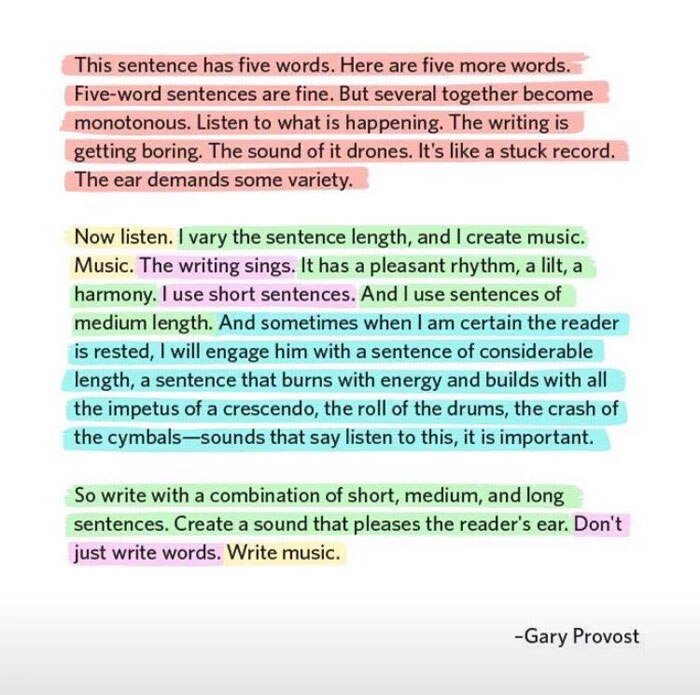
Good writing tends to flow by interspersing long and short sentences together.
I think this happens subconsciously, and you shouldn’t deliberately or mathematically calculate this.
Make it personal
Zinsser advocates using 1st person : ‘I, Me, Mine’. You want to share your opinion and personal outlook. Tell your own story.
In school, I was told by English teachers to write impartially. ‘Hemingway’s description of the Old man symbolises blah blah’. Literary analysis is boring and dry.
It is far more interesting to share YOUR opinion, your stories, and what YOU’VE LEARNT. “Writing is an act of ego”.
Be open, honest and vulnerable. Authentic. Share a story.
Write for Yourself
A good book is like a conversation. And like all conversation, it goes through the filter of life experiences, outlook and disposition of the listener or reader. Each reader experiences a book differently. Even the same reader at different points in life experiences a book differently. “No man steps in the same river twice”.
I remember I enjoyed ‘Zen and the Art of Motorcycle Maintenance’ as a teenager. But re-reading it now, it does nothing. It seems long and convoluted.
Similarly, I read Marcus Aurelius ‘Meditations’ as a teen. I barely made it past the third page. But I picked it up again in my early 20’s, and it radically changed my life.
The point is, you can’t guarantee a reader will connect. But you can guarantee that you write for yourself. To satisfy your own intellectual curiosity, or simply because you have something important to say.
Write for an audience of one : yourself.
This might seem contrary to the previous advice. But It’s a matter of technique vs style. Like a woodworker - technique is like perfecting the skills of cutting, sanding, lacquering etc. But at the end of the day, you want to create because you are compelled.
Read
All the best artists steal. You learn by imitation. If writing is like gardening, reading is like choosing the seeds you want to plant. Read widely, and read deeply.
There are no rules for reading
Random Rules
There is no prescription in writing. Writing in the passive voice doesn’t automatically make it dull, but here are a few rules Zinsser advocates:
- Keep paragraphs short - writing is visual. A long chunk of text can discourage a reader from even starting
- Organise your piece into subsections
- Active : ‘Joe saw him’ - is stronger than ‘He was seen by Joe’
- Write about your interests
Lastly, Writing is not a contest. It’s a process.
My Process
- Follow genuine intellectual curiosity
- Read about the topic
- Leave it in your subconscious
- If you feel compelled - write about it
- Then re-read through- and trim the fat
- Publish (if low stakes)
- Otherwise, re-write, re-write re-write.
Zinnser also suggests reading it out loud. And in higher stakes publication, obviously obtain impartial feedback.
Tools
I basically live my entire life digitally. I have almost no ‘junk’ lying around, because it is stored in ‘0’s and 1’s.
All my notes are digital, all documents, banking/passwords, reading, note taking, journalling, even drawing- is all digital.
Therefore I think a lot about what tools I allow into my life.
Kindle : I remember when I got my first Kindle at the airport when I was 15. I fell in love instantly. Although I do enjoy paper books, the Kindle is far more convenient. Amazon wins in the end anyways. I just end up buying both the digital and physical copies for my favourite reads.
Obsidian : I store any notes I’m compelled to take in .md format, and visualise them in ‘Obsidian’
DayOne : This is the best journalling app out there. I like it because it is entirely private. With paper journals, I feel like I write with someone over my shoulder concerned that one day someone might read it. It stops me from being radically transparent. I type much faster than I write with a pen. I like that it organises notes, doesn’t take up room.
IA Writer : again, I write everything in markdown format. Great app
These are all just personal tools. Everyone has their own preferences and systems. I’m very organised, so like systemically thinking about these topics, but others prefer a much less regimented approach.
Conclusion
I don’t think good writing is intuitive. It is actually really hard. Luckily, I don’t want to ‘become’ a writer. I just like to write.
why meditate?
TLDR : Meditation is a tool to observe the mind
“If you wish to understand your mind, sit down and observe it” - Joseph Goldstein
I consider learning the skill of meditation to be the most important thing I’ve ever learnt in my life. By far.
It is hard to discuss, because it is experiential. Not a belief system, but a methodology for exploring your internal state.
When people ask me about meditation, they tend to have a preconcieved notion of what it is. That it involves some supernatural or irrational belief structure. That is involves growing out your hair, crossing your legs and ‘accessing your 9th Chakra’. “What do you even do. Are you sitting there just not thinking? “. Are you chanting Om in an attempt to gain some sort of ’enlightenment’. Worst one was a Christian girl who said, ‘Uh, I don’t want to join a cult”.
This isn’t helped by the new surge in the ‘self help meditation’ movement. The word has lost its meaning. Being used by the next guru to influence others, or sell copies of their book. ‘To think positive thoughts’.
It is a 1st person science
First of all. I just want to say, I am through and through, a scientist. I am one of the biggest skeptics of dogma and any claims that are unsupported. I caused a lot of trouble in my philosophy and ethics class, questioning from first principles. You can dismantle most dogma by asking ‘why’. My inherent disposition is one of doubt
And in my initial dive into Buddhist/Eastern philosophy, the first sentence I read was :
“Don’t blindly believe what I say. Don’t believe me because others convince you of my words. Don’t believe anything you see, read, or hear from others, whether of authority, religious teachers or texts. Don’t rely on logic alone, nor speculation.” - Buddha
That piqued my interest. And down the rabbit hole I went.
Meditation is a practice
The first thing is : meditation is a practice. It is like lifting weights or exercising in the gym. There is no authority. It is a simple set of exercises you do with your mind. It is radically scientific. Based on an epistemological stance of questioning entirely from first principles. Obviously there is religious muddying, where a lot of Eastern ‘Buddhists’ don’t even meditate. There are always attempts to institutionalise and solidify power.
But the practice itself is independent of any dogma. You don’t need to be a Buddhist or a Christian or a Hindu. Meditation is not ‘Buddhist’ insofar as the Laws of physics are not ‘Christian’ (even though discovered by Christians) or Algebra is not Islamic (even thought discovered by Muslims).
It is a set of mental exercises that produce lasting changes in the brain.
One of the initial instructions is so basic, that is is laughable. " Just sit and pay attention to your own breath”
So you sit down and you try to pay attention. Ok. Its going well. 5 seconds in. Wow, I am really doing it. This is great, I wonder what Jess would think of this, I think she would flip out. I don’t really like her to be honest, I wonder if she likes me. What did I have for lunch today. Salmon. Salman Rushdie is such a great author…
And you are lost. Without training, this is how one spends their entire life. Without even realising it.
I remember I couldn’t even focus on the breath for 2 seconds. The worst part was realising that I had thought I was paying attention to my thoughts, that I ‘understood’ myself, and absolutely destroying that belief. I really did not understand my mind in the slightest.
You are trapped in a spell. This is the normal mind before any training in meditation. You don’t realise it, but for your whole life you have been lost in thought, without knowing necessarily that you are thinking.
The problem is most of our ‘default patterns of thought’ skew in a negative light. Wandering minds are unhappy minds- as a famous Neuroscience paper put it. Being scattered is not a pleasant feeling. Being focused is pleasant.
There are states of conscious experience that are available that are radically free of suffering. Full of intense joy, equanimity and free of aversion.
If you can’t focus on your breath for 5 seconds, how can you focus on something infinitely more complex, such as grief or sadness or boredom? There is something to discover here.
There are states you can get into that are radically different from normal perception.
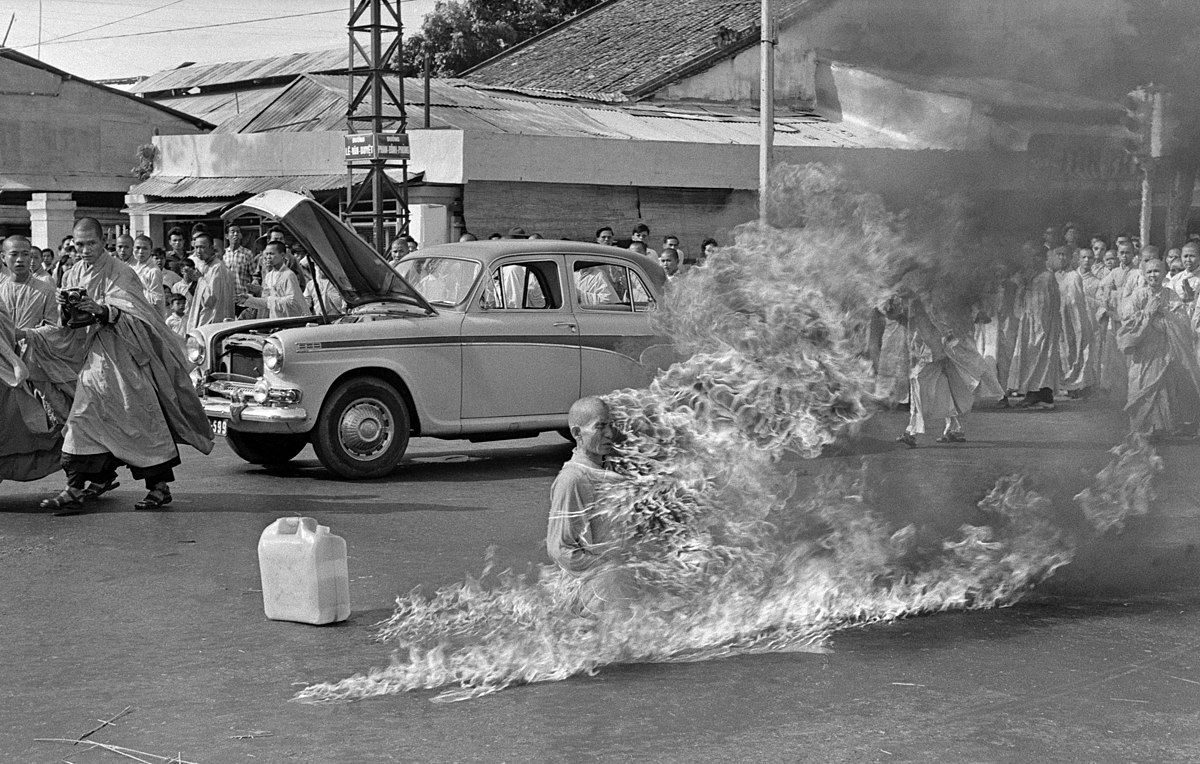
Types of Meditation
Meditation is an incredibly broad term. It is like saying ‘Exercise’. It can encompass Gymnastics training to Olympic weightlifting to simply walking in the park.
There are many different techniques. However one that has gained some degree of popularity is the 2500 year old ‘Mindfulness’ meditation in the Buddhist Theravadan tradition. : Vipassana-Samatha meditation. But there are many more : in the Zen (soto) tradition. Tibetan Dgzochen practice. They all ultimately target the same root.
Mindfulness is a quality of mind that allows you to pay attention to whatever arises without being lost in the thought. It is a radically different way of relating to experience.
Instead of being lost in thought about an event, you can relate to it differently. Suppose you replay an embarrassing moment. That triggers feelings of guilt/sadness or the whole panoply of emotions available. That story then leads to another story ‘I am boring, or I am stupid’. Any sort of belief structure. That habit or pattern of thought repeated, cements itself. People can literally be angry for hours or days. People can stay angry and resentful for years against someone who has wronged them, even when it is not useful.
You are lost in a story that you are overlaying onto sensation.
What this training does, at a basic level, is it grants mental autonomy to ‘drop’ the pattern immediately. To see the thought, to observe the mind, without being lost in the stories. To see sadness or grief or joy for what it is. As sensations in the body. Or internal dialogue or imagery.
“You can drop whatever pattern you are lost in”. Instantly.
An analogy I like is this. Suppose you are waiting at the train station. A thought arises. This is like the train pulling up at the station. The default response that 99.9% of humanity experiences is that they get on the train, and are whisked away by the thought. Taken in all sorts of directions, onto new trains". All at the mercy of the next arising thought in consciousness.
There is another option.
What this training does is. : allows you to see the train coming. And then choose not to get on.
Not always. It is difficult. But suddenly having that mental autonomy, you have a radically different way of relating to experience. One with much less misery and suffering. And much more peace and contentment.
The brains of meditators are objectively different
There is objective scientific evidence that there are structural changes in the brain of long term meditators. For example : Studies looking at monks with lifetime hours of 40,000+ show that there are changes in the pattern of brain waves with more alpha waves present.
The activity in a set of structures called the ‘Default mode network’ is different. The DFMN is responsible for discursive thought that arises when you are ‘doing nothing’. It is the backdrop of your conscious experience. The DFMN is quieter in long term meditators. It doesn’t light up as much as in non-meditators
I don’t intend to make this blog post a deep dive into the literature. But there is an excellent book called ‘The Science of Meditation’ that explores some of the studies done.
Internally direct attention
Basic training involves the ability to direct attention to some level. It gives you the tool to explore your internal world. How do thoughts arise? What is a thought? Where is it?
Through this exploration, you can come to realise the causes of ‘misery, unsatisfactoriness, discontent’. Whatever you want to call it.
At the root level, what this training allows one to do, is to experience real contentment. Not waiting for any external factor to change. But to experience contentment independent of any conditions.
As a default state, humans have evolved to be ‘discontented’. We want better things. We want to push away negative experience. We want to cling to positive experience. Evolutionarily this makes sense.
But both negative and positive experience are fleeting. Any negative experience will fade. Any positive experience will fade. Experience is ephemeral. Here one moment and gone the next. Any attempt to cling or hold on, is painful.
We go through life constantly chasing desires and pushing away negative experiences. This creates a level of ‘misery’, unsatisfactoriness, suffering. Use whatever terminology. But there is an angst. You can experience this by going on a retreat paradoxically. Just try and sit with your untrained mind for 30 minutes. Literally doing nothing. It won’t be pleasant I can promise.
Part of what this training does, is to allow you to understand desire and aversion. And then choose a middle way.
It’s like everyone is on a beach. When the tide comes in, they are running away. When the tide subsides, they are running towards it. Perpetually lost in a cycle of pushing, and pulling at experience. Wanting and not wanting.
But there is a middle way. To simply lie down on the sand and let the tide wash over you, finding joy in the experience.
Deeper Realisations : Illusory nature of the self, Impermanence, Suffering
I think the core of what these traditions point towards is the selfless nature of experience. More accurately, the self as we think of it, is not what it seems.
If you’ve had any training in neuroscience. This is obvious to you, at least from an intellectual standpoint. We are hallucinating our reality. The brain is a virtual reality headset constructing reality using data from our sense organs. And with that, there really no ‘unchanging self’.
There is no soul. No unchanging self. No constant unchanging entity you call ‘You’. There is a constant flux of change. Your cells are constantly dividing. There is no ‘place in the brain’ that houses the self. The brain can instead be seen as a boardroom with various subminds vying for conscious experience. You are literally not the same person as you were once you finish reading this sentence.
Furthermore from physics, we know that we are not ‘independent’. We are deeply interconnected. Where is the ‘self’ in the collection of atoms that compose you. Are you your body? Are you the brain? ‘You’ really are nowhere to be found.
But of course, you feel like a self at the moment. There is a narrative structure to your experience. You went to school in Bedford. You like Greek style yogurt. You look like ’this’. But if you look closely, can see a narrative arising and passing away. You can dissolve the feeling that ‘you are behind your head’.
We actually lose our sense of self a lot I think. Imagine those moments in life, where you were truly immersed in the experience. Probably some of the most joyous experiences in your life. There was no projection of self referential thought. ‘You’ forgot you existed. There was just total immersion.
The fact is, you can see this inherent lack of self, lack of centre, as easily as you can see your blindspot. It’s not a matter of ‘progressing’ or ‘becoming a better meditator’. There is no ’enlightenment’ where all your psychological problems dissolve and you permanently become a superior being. That is nonsense.
But you can see the inherent lack of self. And in that, there is a tremendous unity. It’s hard to describe. People can experience this when they take psychedelics. It’s like, there is really no centre to experience. There is just the arising and passing away of phenomena. And where you are, there is just the universe. An intense feeling of interconnectedness.
Please don’t take this as the truth. But as an avenue to explore yourself. Some Zen teachers famously were quite ‘violent’ in their objection to theorising, encouraging instead to simply sit and explore.
It is a hypothesis you can test. There are a set of techniques that allow you to explore your internal experience, and see this for yourself. It is not mystical, it is not magical. But it is strange and profound.
Conclusion
Ultimately, it is about understanding your mind.
This is what I think ‘Spirituality’ is. Thomas Metzinger, a philosopher - articulates this well in his essay : ‘Spirituality and Intellectual Honesty’.
Science is an exploration of the external world coming coming from a place of questioning. The telescope is an instrument we can use to discern this external reality.
Spirituality is an exploration of the internal subjective world coming from a place of questioning. Meditation is a tool we can use to greater discern this internal reality. It sharpens the faculty of attention.
There is much more to be said on this topic.
Starting Points :
corona
There is a Chinese ‘curse’ that is translated as
“May you live in interesting times”.
I’d say this is one of those. I want to explore a few predictions on what coronavirus could do for humanity. As well as my current thoughts on the topic
It’s ok not to have an opinion
Everyone has something to say on COVID. Ironically, I’m now writing my opinion on COVID.
But amongst the deluge of information we are consuming, it is ok to say “I don’t know”. Because for 99% of humanity, this is the case. Most people are not epidemiologists or virologists.
I don’t know the repercussions of COVID. I don’t know how it will pan out for society and the economy. I don’t know how many lives will be lost.
At best all we have are models and predictions. But the ‘map is not the territory’. Acknowledging our limited understanding is crucial and finding some comfort in uncertainty can be valuable.
Information Overload and Misinformation
The 24/7 news cycle is something we’ve all become accustomed to. I usually don’t consume any news at all as I found it too distracting and often the most important news tends to find itself to me through others.
However recently, I’ve been sucked into reading about COVID, and I can’t stop. It really doesn’t add anything valuable.
Furthermore, there is spreading of misinformation on these online platforms, that is hard to avoid. From ’10 ways to boost your immune system’ to Charlatans peddling cures for financial gain.
I see this a lot of WhatsApp and Twitter. Some from doctors which is appalling.
The response is to treat information you read with skepticism, and to trust reputable sources only (e.g. WHO).
Black Swan Events
Taleb describes a black swan as an event that 1) is beyond normal expectations that is so rare that even the possibility that it might occur is unknown, 2) has a catastrophic impact when it does occur, and 3) is explained in hindsight as if it were actually predictable
Although, it doesn’t meet 1) - we definitely knew a pandemic was incoming at some point. This whole ordeal has made me think about Black Swan events.
How you should reduce your exposure to negative Black Swans- for example by having savings etc. And try and increase exposure to positive Black Swans.
Predictions on Impact
- More emphasis on Science and Technology - increased funding
- Distributed working : working from home will become a norm
- Increased compensation for healthcare workers and scientists as the public opinion changes.
- ‘Telemedicine’ will become more integrated into the system
- Global cooperation as this can be a demonstration that humanity can work towards a singular goal
- Better preparation for future global pandemics and crises (Global warming, Nuclear war, Technological disruption)
- There will be second order impacts that we won’t see coming. Maybe a spike in birth rates (or divorce) as people are at home. Maybe new handle resistant bugs due to the widespread use of hand sanitiser. Don’t get me started on toilet paper stocks.
Ending
I don’t have much to say about Coronavirus, because I don’t really know much. But reading a lot of Sci-fi has given me an inbuilt optimism about humanity. We have the potential for so much good.
Currently, the hospital is eerily quiet. 300+ empty beds.
I hope that we can avoid the worst.