title: deloads and keeping the flywheel spinning date: 2022-02-19
Long term consistency trumps short term intensity
Bruce Lee
There is a concept in training called ‘periodisation’.
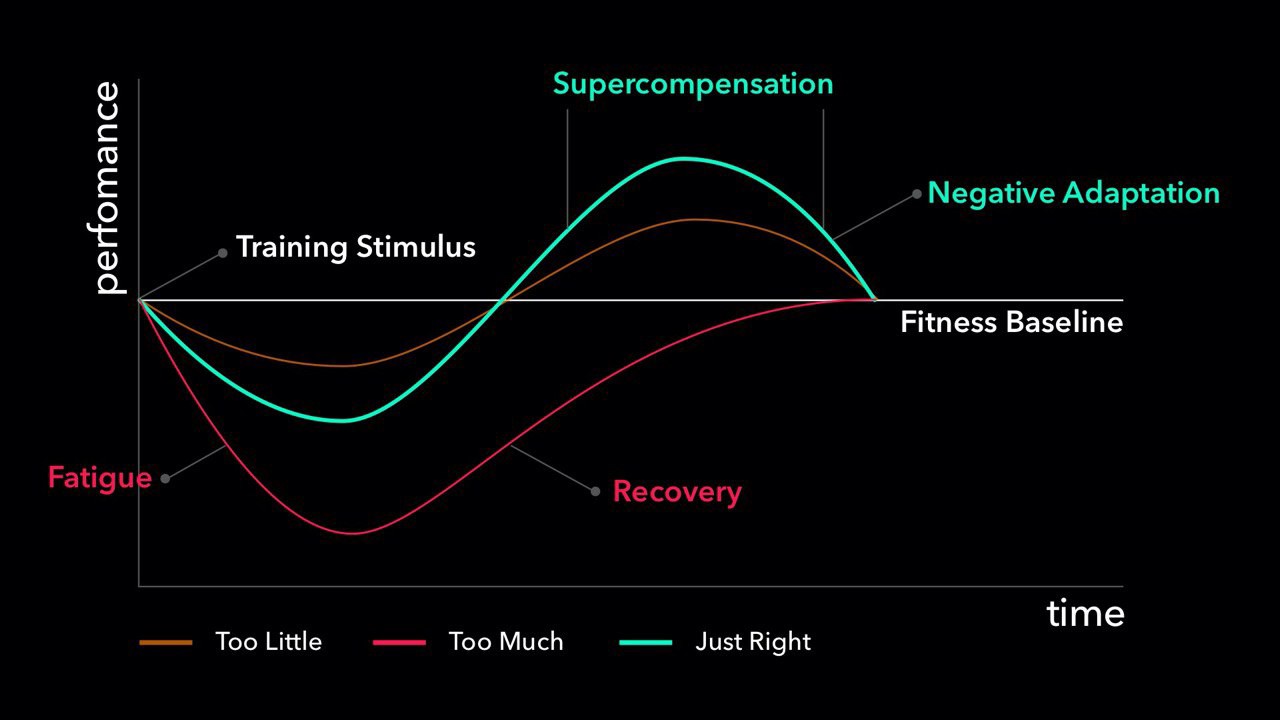
Simply put : You can’t keep adding 5lbs to the bar and expecting it to go up. You don’t make linear progress at a certain point. Therefore the ‘way’ you train becomes crucial.
You have to take regular ‘deload’ weeks where you reduce the CNS fatigue and stress, and allow the body to recover. In fitness, this is normally every 6-8 weeks depending on the program.
Therefore the trajectory of improvement then looks like this.
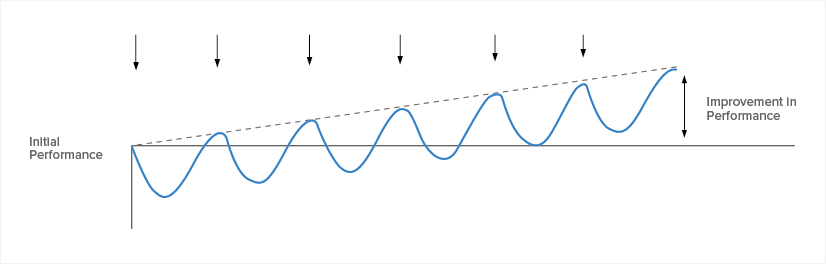
If you intend to train long term (which you should), then deload weeks are non-negotiable. All intermediate-advanced-elite athletes know this. Sub-maximal training is crucial to getting to that stage.
But the concept of deload weeks is generalisable to more than just fitness.
On an intellectual level, you can keep burning the candle at both ends. Short term intensity is required, but so is rest. This is why people ‘burn out’.
For ‘Type A’ people, putting the foot on the accelerator is easy. They’ve been doing it their whole lives. Intuitively it makes sense. More time, more work, more intensity means better results.
In the short term this is true. But if you are playing long term games, this is the wrong approach.
Sprint, Rest and Reassess
Progress in any endeavour is not linear. Train smart. Rest. Reassess and Sprint.
In ultra-long term endeavours - think mastery in a skill such as writing/programming/music. You want daily consistent work.
The author Murakami advises that you stop writing at the moment you know you could do more. Then the next day you are still energising to continue writing. Therefore the flywheel keeps on spinning.
TLDR: Submaximal training allows for consistent long term progress
title: creation and eyeballs date: 2021-07-30
TLDR : Shower thoughts and too much time on psychiatry
I stumbled on a vlog on social media, recorded in 2012 by Nerdwriter1. One line caught my attention :
“Whatever medium of shared expression you choose will be the medium by which you’re asking to be judged…”
Facebook/Instagram/Twitter are not private journals and they are posted with the knowledge that others will see it, and react to it. Some part of the creation process is performative. It’s a throwback to a thought on digital identity where I mentioned the ‘Looking glass theory’ of the self.
We create a self model based on what others think we are.
I’m coming to realise that sharing any creation has a performative element to it. We want to be perceived in a certain way. That’s not a bad thing, but its interesting to watch it. How do I want others to perceive me? And is there a big mismatch between my perception of myself, and others perception of myself?
I think I’ve come a fairly healthy place from which to use social media. But I want to remind myself/future self that there is value in anonymous and private creation too. Not everything has to be shared.
“Not everyone has to be an artist… but there is something to be said for a little bit of reserve when it comes to expression, that way you can preserve some of your own mystery… you can escape some unnecessary judgement and you can recover the power of your own voice”
I’m looking back at some old posts on this blog, and slightly cringing. I imagine I’ll do the same when I look back in 5 years time. I’ve written some short sci-fi stories that I’m going to spare anyone the trouble of suffering through. But I enjoyed the process of creating it for the sake of creating it. I’ll keep them private/draft on the blog.
It shifts the motivation from an ’extrinsic to intrinsic’. I think to be peaceful, you should line up as many aspects of your life such that you are acting from a place of intrinsic motivation.
That said, I can share this post and any future posts with the awareness that I kind of want to be perceived in a certain way, but that’s ok. Just don’t let that become the focus.
title: best generic career advice date: 2022-03-22
If anyone asks me for advice on how to know if they should pursue a hobby / job / career / spend more time with a person, a safe and actually very useful heuristic is:
Pick the thing where you lose track of time when you do it
It automatically fixes a whole bunch of priorities. If time is flowing easily, it means that
- You can do more of it
- The self is not overly salient. No self rumination. Therefore : Joy or at least deep focus
- Because you do more of it, you improve
- Because you improve, you do more of it. Repeat cycle.
What does it require?
- Uninterrupted deep focus
- Collaborative and competitive environments
- Apprenticeship - you need to be under a master/mentor
- Not seeking external reward- autotelic. You do it because you intrinsically enjoy it.
After our basic needs are met: food, clothes, shelter- what we are really seeking are states of mind.
And I’m pretty sure this is a consistent peak of ‘human experience’ in Sam Harris’s analogy of the peaks and valleys of human suffering/flourishing.
It’s my go-to generic crisis advice at the moment. But of course, the topic is always more complex and individual dependent. We can’t all find a career or job where you are losing track of time. But you need to get that somewhere.
So if you find a person/hobby/skill/job where you’re consistently losing track of time - I think you’ve hit a winner.