exams and understanding
Summary : thoughts on exams
If you want to build a ship, don’t drum up the men to gather wood, divide the work, and give orders. Instead, teach them to yearn for the vast and endless sea” Antoine de Saint-Exupéry
Approaching half way through third year of medical school, I’ve had a decent exposure to examinations to say the least. Medical school is a strange place in that you see people on a wide spectrum- those who are absolutely dependent on external validation from exams, and those that say that exams are completely worthless. Both are a cause for concern, and believing in extremes is never a good starting point.
In one way both tend to sacrifice understanding. The overly obsessed, anxious student aiming only for a good ranking can sacrifice understanding preferring to ‘rote learn’ topics. In fact this was the approach my parents had to undertake in the Indian medical school system in the late 1900’s – and they both unequivocally agree that the approach is flawed.
On the other end of the spectrum, the student can become so dejected by the notion of exams that they fail to put in any effort. So what is the solution?
can you explain it to a 5 year old?
I recently came across the ‘Feynman technique’ for learning. The premise is that
- You choose a concept/topic you want to understand
- Proceed to explain the idea to yourself as you write- as if explaining to a new student / layman/ toddler / 5 year old- or whoever you want.
- The crucial part is that you vocalise the process and use easy to understand terminology.
if you can explain it simply then you understand it deeply
Now is it perfect? Depends on your yardstick of measurement. If your measure is exams, then no, it isn’t perfect. You will miss marks on those inane questions that demand you to memorise pointless facts. But will you gain an understanding of a topic for years and years to come that? Yes
Learning in medical school does of course involve memorising certain facts – for example drugs. But even then, I think that due to technology and storage of information, this shouldn’t be the highest priority.
In fact modern day hospitals are run mainly bureaucratically though guidelines on exactly ‘what’ drug to prescribe and how much, so the whether or not the doctor knows a certain drug doesn’t matter- what does matter is that he understands the reasoning behind it. Things have changed a lot since my parents were in medical school.
learn out of curiosity
Merely to acquire information or knowledge is not to learn. Learning implies the love of understanding and the love of doing a thing for itself. Learning is possible only when there is no coercion of any kind” Jiddu Krishnamurti
Ultimately exams are a necessary evil- but should you put your mental wellbeing on the line to achieve the highest grade possible? I guess that is a personal question that I can’t answer for individuals but atleast I can shed some light on my own experience.
What is more important I feel is not to become dejected by the learning process through examinations. I’ve had periods where I (feeling both internally and externally inadequate) worked intensely hard for exams with idea of‘do or die’ and I’ve had periods where I was so demoralised by the process that I stopped.
It is crucial to remember that learning is life long, knowledge is not an end, but a process. Always ask questions. Always be open to learning. In our 20’s, ego tends to flair up for many where with growing knowledge and pressure of performing and success we pretend we understand more than we do (‘scientia infla: knowledge puffs up).
Instead as Bruce Lee advocates- ’empty your mind’. Be receptive and admit when you don’t understand topics.
To conclude, take it step by step: iteration is crucial in any form of long term endeavour. Only by understanding simple concepts can you build on those to grasp more complex ones. Enjoy the process and don’t become fixated on outcomes, (especially those as trivial as examinations).
The Art of Gathering
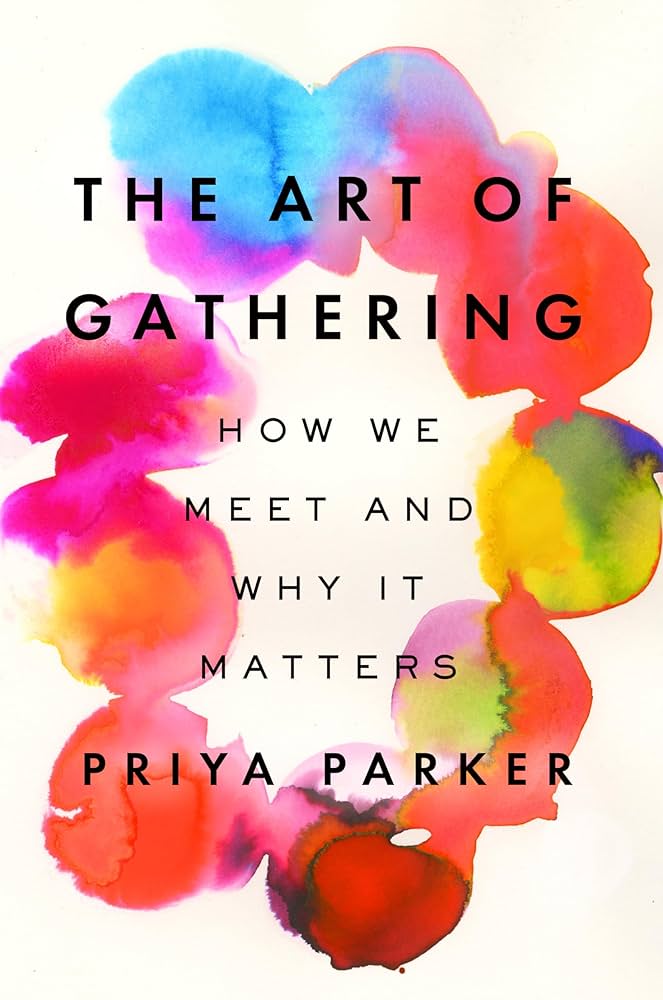
‘How we meet’ is a vital human experience, but too often we don’t give it enough thought.
We spend our lives gathering, with family, friends, in school, at weddings, business meetings, class reunions, dinner parties, sports groups, religious ceremonies, and at the end of our lives, our loved ones gather at our funerals.
We all intuitively know that gathering is important. We can look back and remember times that ‘we gathered well’ and times that weren’t so well. The awkward dinner party where one too many guests were invited, or the social where you weren’t very social.
More and more, we are unhappy with the way we meet. Going to conferences, work meetings or drinks parties, we find that the host has rarely given thought to how guests will connect, why they are meeting, and what they will take away.
There are ways that you can ‘gather well’.
1. Know why you are gathering
You should be explicit to yourself in why exactly you are gathering. ‘Think less about the what, and more about the why’. For example:
Take a birthday. If your ‘why’ is to surround yourself with your loved ones, then invite a small group and have an intimate dinner. If your ‘why’ is to reconnect with old friends and colleagues- then invite a larger group for a barbecue.
Knowing why you are gathering, is the starting point for the rest of your decision making
2. Good gathering requires exclusion
Once you know the underlying purpose of the gathering, you can choose who to invite. And more importantly, who to exclude.
Include only people relevant to the gathering. If you intend to spend time with your school friends, and the intention is to ‘catch up’ - don’t invite a work colleague. (Unless the intention is to meet new people).
The ‘more the merrier’ is not true. How many people depends on the ‘reason why you are gathering’.
3. Don’t be a ‘chill host’
An engaging and generously authoritative host will always deliver than a laid back host
Hosting is a skill. It requires attention and effort. An abdication of power as a host often fails guests rather than serving them.
You have ‘power’ as a host. The author talks about a time she was at a housewarming party, and there was a lull after dinner. The author suggested that they play a game of ‘werewolf’ but the host wasn’t sure that ‘everyone’ would enjoy it. They were unwilling to exercise their power. As a result, the moment passed and the party broke up in an unsatisfying way.
Another example was where the author facilitated a conference with the purpose being to bring together people involved in the agricultural industry. There were 120 people who didn’t know each other. So she utilised her power as a host, and asked that every attendee get up and move to a different table after each speech. Initially it seemed like an imposition, but ultimately at the end of the day, everyone was grateful. This simple rule facilitated the reason ‘why’ they were implicitly gathering - to form new connections. By being at the same table the whole time, they wouldn’t fulfil that purpose.
4. Having rules can be freeing
An addendum to the above. Depending on the gathering, you can set rules as a host. Exercise that power.
Rules can allow for playfulness and meaningful gatherings. Examples include : no phones, arbitrary mixing rules at a social.
5. Introductions and Starts
Prime people before the event of what to expect. Give them a little synopsis. If hosting a dinner, let people know who is coming, what you will be serving, any activities planned, and roughly when it will start and finish.
Then when they arrive, acknowledge this explicitly. Make introductions if needed. Serve them food/drinks. Show them around if a dinner.
6. Encourage authenticity
We all crave authentic interaction. I’ve been in situations where the conversation barely left the superficial, and then led to the group just sitting next to each other on their phones. Most gatherings in university were disappointing in my experience.
How can you encourage authenticity? This is another intention you must hold as a host, and there is no one way. You cannot demand authenticity, but you can create an environment which fosters it.
You can make guests feel comfortable. You can be vulnerable yourself. You can ask for stories about other people’s lives. How to tell stories is a skill itself.
7. Endings
Have an explicit ending. The peak end heuristic states that we remember the peak and the end of any experiences the most.
Therefore ‘how things end’ matters a lot. Make it explicit- if for example hosting a dinner party, you can let guests know that they can leave if they want to, but if they choose to stay they can retreat to the living room etc.
8. Create rituals
Ritualised and regular meet ups are powerful. Try to commit or create a group around a shared purpose. Then aim to meet regularly. This is how you form deeper bonds.
Examples
- Sunday brunch
- Coffee and climb
- Evening walk
- Sports clubs
Conclusion
Be the host. Don’t wait for others to open their door. Open yours.
20 years old
It’s strange that people only talk about ‘half’ years when they are either really young or really old. “I’m 4 and a half” or “I’m 91 and a half”. I think the rest of us are missing out. Six months is a long period of time and one that perhaps deserves recognition.
In an attempt to ‘celebrate’ that fact, and partly due to procrastination, I’ve decided to undertake a deep introspection of what I feel to be most important in life. I would love to look back at this and see how my views have evolved or changed, maybe even write a followup when I hit 30 and a half…
1. “You know nothing Jon Snow”
The fact is that I know nothing. Nothing beyond my initial surroundings, interactions and schoolings. With that comes only a deep respect for everyone I encounter, since they have a unique experience of life and a perspective that can offer a view on the world. I try to listen to everyone.
2. A life not shared is a life not lived
I identify as an introvert. That doesn’t mean I prefer to sulk away in the corner and keep to myself. It just means most of the time I prefer to do that. Yet I have an incredible gratefulness for family and friends. They are the people you can share your happiness with, or troubles when the time comes. That said, I could definitely work on trying to be more sociable though. A close friend who loves to initiate deep philosophical chats that I am never prepared for once told me – “We avoid risks in life in order to arrive safely at death”. I’m sure he stole that one from somewhere.
3. Health is one of the best gifts you can give yourself
A tangible sense of dread would wash over me when I had to do any form of physical exercise in my early teens. The bleep test was the stuff of nightmares. My diet was reasonable, mostly due to the blessing of a health conscious mother, but needless to say, cardio was a word I was not aware of. I would love to say how I was inspired to change, but in fact it was just the underestimated power of establishing a routine. I started going to the gym and lifting weights. I force myself to go and she process becomes mechanical. Heeding the wisdom of the modern philosopher Shia LeBoeuf, “Just do it”.
4. Travel
I am incredibly fortunate to have had the opportunity to travel and experience living life in a different culture. I was born and raised in India till the age of six and that was when I moved to England, with a basic understanding of the language. I remember running to my Father in blockbuster because I had no idea how to speak to the staff about renting a DVD. The fact is that humanity is incredibly diverse. There are different cultures, systems, environments, climates and most importantly, people. It would be extremely limiting not to experience the countless ways that humans around the globe live their lives.
5. Culminate a deep passion for whatever you want
I didn’t get into medical school in my first year. I try and rationalise that by saying that “I didn’t work hard enough”, which is partly true. Looking back however, it was because I lacked a passion in what I wanted to pursue. I imagine that apathy came through in my interviews. What has become more clear, is that having a grounded sense of ambition and passion and throwing yourself into what interests you the most, seems to ‘feel good’. Currently that seems to be picking away at my guitar, reading and ‘being a medical student’… I’m loving it.
6. Be Open and Honest
It’s a simple concept that I prefer referring to as being ‘chill’. Language is undermined with gossip, exaggeration or deceit and I find that by coming from a place of honesty, much the deadly sins of language seem to vanish. I’m probably one of the worst people to gossip with. By being open and honest, you tend to polarise people who harbour animosity or ulterior motives and attract those who like your company. Although it’s a cliche topic and I cringe writing it, a fantastic quote by Dr Seuss encompasses the idea perfectly.
“Be who you are and say what you feel, because those who mind don’t matter and those who matter don’t mind.”
7. Reading is food for the soul
Reading offers perspective. One author I strongly recommend is Atul Gawande. He is an incredibly relatable author who talks about a range of topics from mortality, to the use of checklists in surgery to inevitable complications in medicine. His most recent book called ‘Being Mortal’ explores how medicine is not coping with balancing technological advances with the needs of the ageing population. He delves deeply into what really matters in the final moments of life, essential insight that I think every healthcare professional should have. It had me in tears at points and has changed my perspective on end of life. That is the boon of literature.
7 1/2. Sweet Potato is a gift from God
A brief point. Cooking has been an incredibly frustrating yet endlessly rewarding task. I have found solace in sweet potato. Following the timeless advice of Samwell Gamgee- “Boil em, mash em, stick em in a stew”.
8. Gratitude
“True happiness is to enjoy the present, without anxious dependence upon the future, not to amuse ourselves with either hopes or fears but to rest satisfied with what we have, which is sufficient, for he that is so wants nothing. The greatest blessings of mankind are within us and within our reach. A wise man is content with his lot, whatever it may be, without wishing for what he has not.” ― Seneca
I’ve been reading about stoicism lately and have found it endlessly enlightening. I love this quote but also really don’t want to sound like the philosophy student spouting garbage from that scene in ‘Good Will Hunting’ so rather than analyse it, I just take it at face value- to be grateful for what you have.
Grateful for family and friends, for an education, for shelter and food and of course for good coffee. Even gratefulness in the smallest of things has resulted in feeling incredibly satisfied.
Side note:
If I am reading this in ten years time, keep writing. No matter how convoluted and nonsensical it may be.